

Rendering has always been one of the most demanding stages of the 3D and VFX pipeline. As scenes become heavier, simulations become more complex, and artists expect faster feedback, the traditional CPU-based approach to rendering faces increasing pressure.
This is where Redshift has become particularly interesting.
Developed as a GPU-accelerated production renderer and now part of Maxon's ecosystem, Redshift represents a broader shift in how modern CGI and VFX scenes are rendered. Its importance is not simply that it can produce images quickly. The more interesting story is how GPU rendering changes the relationship between hardware, scene complexity, look development, and production workflows.
From CPU Rendering to GPU Rendering
For many years, CPU rendering was the standard approach for high-end production. Render engines such as Arnold, V-Ray, RenderMan, and others were designed around increasingly powerful multi-core processors.
GPUs changed that equation.
Modern GPUs contain thousands of parallel processing cores designed to perform large numbers of calculations simultaneously. Rendering is particularly well suited to this type of parallel computation because many operations involved in shading, lighting, ray tracing, and sampling can be processed concurrently.
Redshift was built around this idea from the beginning.
Rather than treating the GPU as an additional accelerator attached to a traditional CPU renderer, Redshift was designed as a renderer optimized around GPU hardware. This allowed it to take advantage of the enormous parallel processing capabilities of modern graphics cards.
The result is not simply faster final rendering. It can fundamentally change how artists work.
Interactive Rendering Is the Bigger Advantage
Raw render time is an obvious metric when comparing renderers, but it is not necessarily the most important one.
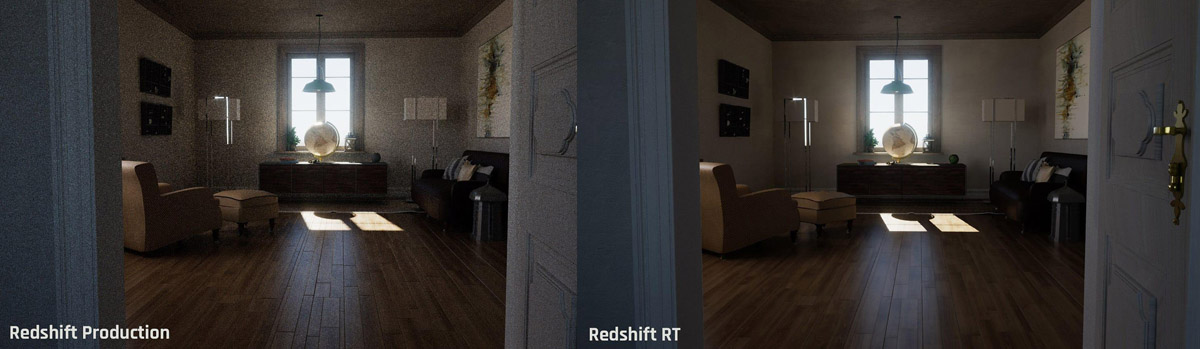
For artists, feedback time can be more important than final render time.
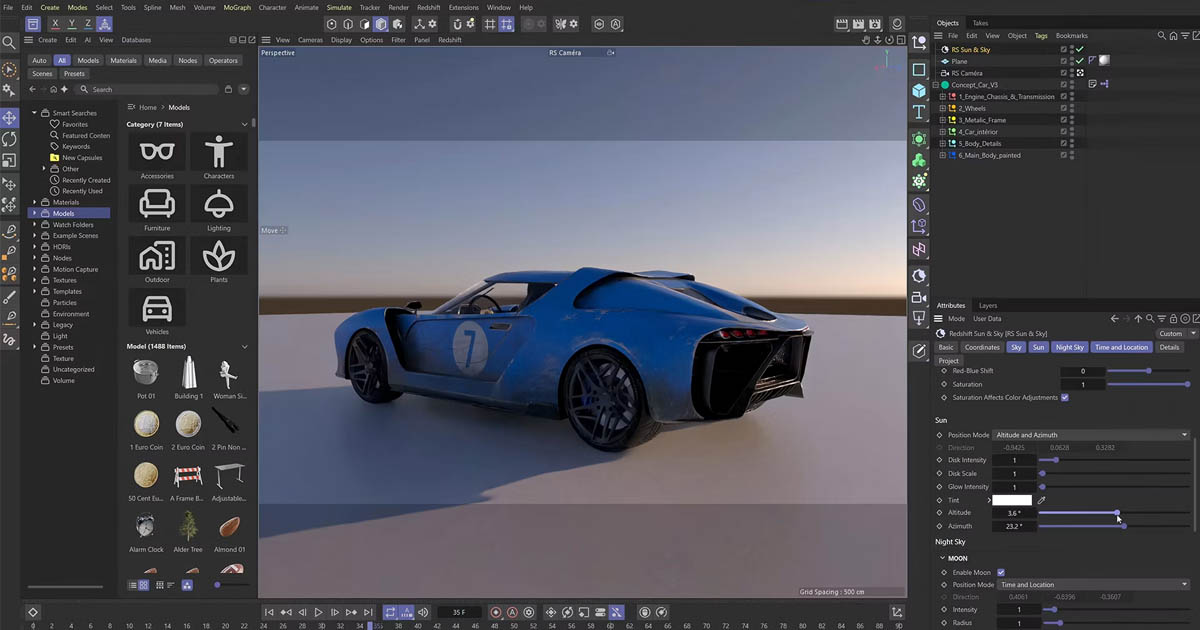
A look-development artist might make dozens or hundreds of small decisions about lighting, materials, textures, camera settings, and composition. If every change requires a long render, experimentation becomes slower and more conservative.
GPU rendering can reduce that feedback loop.
Instead of:
Change → Wait → Evaluate → Change → Wait
the workflow can move closer to:
Change → See → Adjust → See again
This is one reason GPU renderers have become increasingly important in look development and motion graphics, where rapid iteration can have a major impact on productivity.
Redshift's interactive rendering capabilities are therefore arguably more significant than simply advertising a particular number of times faster rendering.
The VRAM Problem
GPU rendering, however, introduces an important limitation.
A GPU has a finite amount of VRAM, and traditionally the complexity of a scene was constrained by how much data could fit into that memory.
This creates an obvious problem for VFX.
Modern scenes can contain enormous amounts of geometry, high-resolution textures, caches, environments, particles, and volumetric data. A production scene can easily become larger than the available VRAM on a workstation GPU.
This is where Out-of-Core rendering becomes particularly important.
Rather than requiring the entire scene to reside inside GPU memory, Redshift can move certain data outside the GPU's available VRAM and access it when required.
That does not eliminate the performance cost of limited memory, but it significantly changes the practical limits of GPU rendering.
The important development here is conceptual:
GPU rendering no longer necessarily means that everything must fit inside the GPU.
That makes GPU-based rendering considerably more practical for large production scenes.
Why This Matters for VFX
VFX scenes are rarely simple.
A single shot may combine:
-
high-resolution digital environments
-
detailed character or vehicle geometry
-
procedural assets
-
large texture maps
-
particle systems
-
simulations
-
volumetric effects
-
complex materials
-
multiple light sources
Rendering such scenes requires more than simply having a fast GPU.
Memory management, shading performance, ray-tracing efficiency, texture handling, and support for production applications all become critical.
This is one reason Redshift's development is worth following from a VFX perspective. Its evolution reflects a larger industry challenge: how do you make GPU rendering practical for increasingly complicated production scenes?
Redshift and Procedural Workflows
Another important aspect of modern rendering is the growing importance of procedural content.
Artists increasingly build environments, materials, effects, and entire scenes using procedural systems rather than creating every element manually.
This is particularly relevant in applications such as Houdini, where geometry, simulations, particles, and environments can be generated dynamically.
A renderer therefore needs to handle constantly changing data efficiently.
Redshift's support for procedural materials, volumes, particles, and large scene data makes it particularly relevant to these workflows.
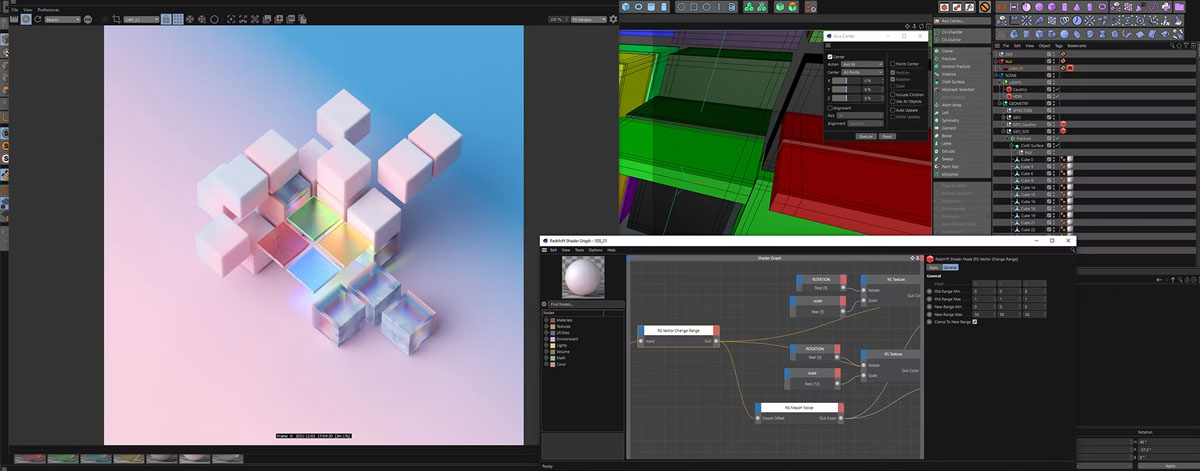
Recent releases have also continued expanding procedural capabilities. For example, Redshift 2026.8 introduced a Scratches Shader for generating surface-wear patterns procedurally, along with High Altitude Clouds for atmospheric environments.
These additions may look relatively small compared with the larger GPU-rendering story, but they illustrate an important direction: modern renderers are increasingly providing tools that allow artists to generate complexity rather than manually author every detail.
Materials Are Becoming More Procedural
Photorealism does not necessarily come from adding more polygons.
Small imperfections often have a disproportionate impact on how believable a rendered object feels.
Perfectly clean surfaces can immediately reveal their CG origin. Real-world materials contain scratches, roughness variation, dirt, wear, subtle color changes, and countless other imperfections.
Procedural shading provides a powerful way to reproduce this complexity.
A procedural scratch system, for example, can generate patterns that can be incorporated into roughness, bump, normal, or other material properties.
This approach has two advantages.
First, the same system can generate variation across many assets.
Second, artists can modify the underlying parameters without having to repaint large texture maps.
For large VFX productions, that flexibility can become much more valuable than a single higher-resolution texture.
Redshift Is No Longer Just About NVIDIA GPUs
The GPU rendering landscape has also become more complicated.
For years, discussions around GPU rendering were closely associated with NVIDIA's CUDA ecosystem. Today, production renderers increasingly need to operate across different hardware platforms.
Redshift supports GPU rendering across NVIDIA, AMD, and Apple Silicon hardware, while also offering CPU and hybrid rendering options.
This is an important development because the future of rendering is unlikely to be defined by a single type of processor.
Instead, production environments are becoming increasingly heterogeneous.
A studio may have:
-
NVIDIA workstations
-
Apple-based artist systems
-
AMD hardware
-
CPU render nodes
-
cloud-based rendering resources
The ability of a renderer to operate across different architectures can therefore become almost as important as its peak performance on one particular GPU.
CPU vs GPU: Is One Replacing the Other?
It is tempting to describe GPU rendering as the replacement for CPU rendering.
The reality is more complicated.
CPUs remain extremely useful because they provide large amounts of system memory, strong general-purpose processing performance, and broad software compatibility.
GPUs excel at highly parallel workloads.
The more realistic future is therefore not necessarily:
CPU → GPU
but:
CPU + GPU + specialized acceleration
Redshift's support for GPU, CPU, and hybrid rendering reflects this broader direction.
The question for production studios is increasingly not simply which processor is faster, but which combination of hardware provides the best balance between performance, memory, scalability, cost, and compatibility.
Redshift in the Modern VFX Pipeline
Another reason Redshift has become significant is its integration into multiple DCC environments.
A renderer becomes much more useful when artists can move between applications without completely changing the rendering philosophy of their pipeline.
Redshift is integrated with applications including Houdini, Maya, Cinema 4D, and 3ds Max, among others.
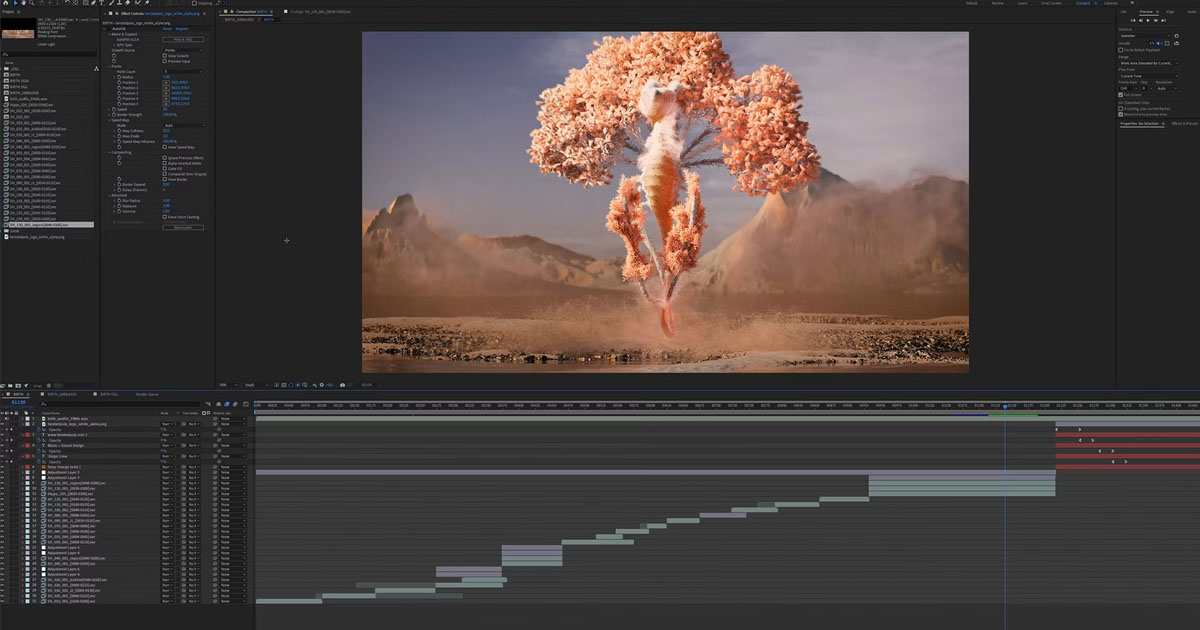
For VFX artists, Houdini integration is particularly interesting because procedural modeling, simulation, destruction, particles, fluids, smoke, fire, and environments can generate enormous amounts of data.
The renderer therefore becomes the final stage of a much larger procedural pipeline.
This is where GPU rendering becomes more than a hardware story.
It becomes a workflow story.
The Real Advantage: Shorter Creative Loops
The most interesting consequence of faster rendering is not that artists spend less time looking at a progress bar.
It is that they can make more creative decisions.
If a lighting adjustment takes seconds instead of minutes, an artist can test multiple variations.
If material changes can be evaluated interactively, look development becomes more exploratory.
If large procedural scenes can be rendered without constantly worrying about GPU memory limits, artists can work at a higher level of complexity.
In other words, faster rendering can change the behavior of artists.
And that may ultimately be more important than the benchmark numbers themselves.
Where Redshift Fits in the Rendering Landscape
Redshift is not the only renderer pushing GPU-based production.
Engines such as V-Ray, OctaneRender, Arnold GPU, and RenderMan have also contributed to the broader transition toward GPU acceleration.
Each takes a somewhat different approach to hardware, features, compatibility, and production workflows.
The important trend is therefore bigger than Redshift itself.
GPU rendering has moved from being an alternative technology used by specific artists into an increasingly normal part of professional CGI production.
As GPU hardware continues to become faster and more capable, the distinction between a "GPU renderer" and a traditional production renderer is likely to become less meaningful.
What Comes Next?
The future of rendering will probably not be defined by raw GPU speed alone.
Three areas are likely to become increasingly important:
Scene scale.
Artists will continue working with larger environments, higher-resolution assets, more complex simulations, and increasingly detailed digital worlds.
Interactivity.
The ability to see lighting, materials, and effects almost immediately will become increasingly important as real-time technologies influence traditional production workflows.
Heterogeneous computing.
Renderers will increasingly need to take advantage of CPUs, GPUs, large system memory, and specialized hardware rather than relying on one processing architecture.
AI will also become part of this evolution, particularly in areas such as denoising, sampling, scene optimization, and content generation. But AI is more likely to complement physically based rendering than completely replace it in high-end production.
The Bigger Picture
Redshift is interesting because it represents more than another renderer competing for benchmark records.
It is part of a larger transformation in the way CGI is produced.
GPU acceleration has changed expectations around rendering speed. Out-of-Core technology has pushed back against GPU memory limitations. Procedural shading has made it easier to create complex material detail, while broader hardware support is making GPU rendering less dependent on a single ecosystem.
The biggest change, however, may be happening at the artist level.
When rendering becomes faster and more interactive, artists can iterate more, experiment more, and make decisions based on visual feedback rather than waiting for the computer to finish.
That is ultimately what makes Redshift's evolution important.
The future of rendering is not simply about producing the final frame faster. It is about making the entire creative process faster, more flexible, and more interactive.
 References & Further Reading

Sadjad Jahangiri 




Add comment