

Universal Scene Description is more than a 3D file format. It represents a different way of building, assembling, and managing complex digital scenes.
For years, visual effects pipelines have relied on a collection of specialized applications. One artist may build an asset in Maya, another may simulate destruction in Houdini, another may handle lighting and rendering, while compositors work in Nuke. Each application has its own scene representation, data structures, and ways of working.
The traditional solution has been interchange: export something from one application, convert or cache it, and import it somewhere else.
That approach works. But as VFX scenes become larger, more procedural, more collaborative, and more frequently revised, simply moving data between applications is no longer the whole problem.
This is where Universal Scene Description (USD) becomes interesting.
USD, developed at Pixar and released as an open-source technology, is designed not only to describe 3D data but also to compose scenes from multiple layers and assets, apply overrides, manage variations, and construct complex scenes without requiring every department to modify the same underlying data.
That distinction is important.
USD is not simply trying to become a better replacement for another geometry format. It is changing the way a digital scene can be assembled and managed.
The Problem Is Bigger Than File Compatibility
At first glance, the VFX pipeline problem seems straightforward:
How do we move a model, animation, camera, or simulation from one application to another?
But large productions quickly reveal a more complicated problem.
A modern shot can contain:
-
characters
-
environments
-
props
-
animation
-
simulations
-
cameras
-
lights
-
materials
-
variations
-
caches
-
effects
-
layout decisions
-
lighting decisions
-
shot-specific modifications
And those elements are rarely finished at the same time.
A character may be modeled months before lighting begins.
An environment may continue to evolve while shots are already being produced.
A simulation may be replaced with a newer version.
Lighting may need to change without modifying the underlying environment.
A shot may require a special variation of an asset without changing the published asset itself.
The real problem, therefore, is not just data exchange.
It is scene composition and change management.
USD was designed around this larger problem.
Why Modern VFX Needed a Different Approach
Traditional interchange often follows a relatively linear pattern:
Application A → Export → File → Import → Application B
If something changes, the process may have to be repeated.
This becomes increasingly inconvenient when multiple departments need to work on the same scene while preserving their own contributions.
USD approaches the problem differently.
Instead of treating the scene as one giant file, USD allows a scene to be composed from multiple layers and assets.
A simplified example might look like this:
SHOT
│
├── Environment
│   ├── Buildings
│   ├── Terrain
│   └── Props
│
├── Characters
│   ├── Character_A
│   └── Character_B
│
├── Animation
│
├── FX
│
├── Lighting
│
└── Shot Overrides
These components do not necessarily have to exist as one monolithic scene.
They can be authored, published, referenced, overridden, and updated independently.
That is the fundamental idea behind USD.
USD Is Not Just Another 3D File Format
This distinction is probably the most important thing to understand about USD.
Formats such as OBJ, FBX and Alembic are extremely useful for moving particular kinds of data between applications. USD can also carry and interchange 3D assets and animation, but its architecture goes much further.
USD provides a scene description and composition system.
Its core concepts include:
-
Layers
-
References
-
Payloads
-
Variants
-
Composition
-
Overrides
-
Scene graphs
-
Relationships between assets
-
Asset resolution
The official OpenUSD documentation describes the system around composition: layers can be stacked, assets can be referenced into larger scenes, payloads can defer loading, and VariantSets can package multiple variations of an asset.
So the better question is not:
“What file format is USD?”
A more useful question is:
“What kind of scene architecture does USD make possible?”
That is where its importance begins.
From Exchanging Files to Composing Scenes
Traditional interchange asks:
“How do I send this object to another application?”
USD can ask a larger question:
“How do I construct the final scene from many independent pieces while preserving their relationships?”
Imagine a production environment containing hundreds of assets.
Instead of creating one enormous file containing everything, a top-level scene can reference individual assets:
Shot.usd
│
├── Character_A.usd
├── Character_B.usd
├── Environment.usd
├── Vehicles.usd
├── FX.usd
└── Lighting.usd
Those assets can themselves be composed from other layers.
The result is a hierarchy of data rather than a single container.
This is one of the reasons USD becomes particularly interesting for large productions: the scene can reflect the structure of the production itself.
The Layering Model
Layering is one of the foundations of USD.
Multiple USD layers can be composed into a final stage, with stronger opinions overriding weaker ones. OpenUSD describes this as stacking layers and resolving their composition into the resulting scene.
Conceptually, it is similar to working with layers in an image-compositing application.
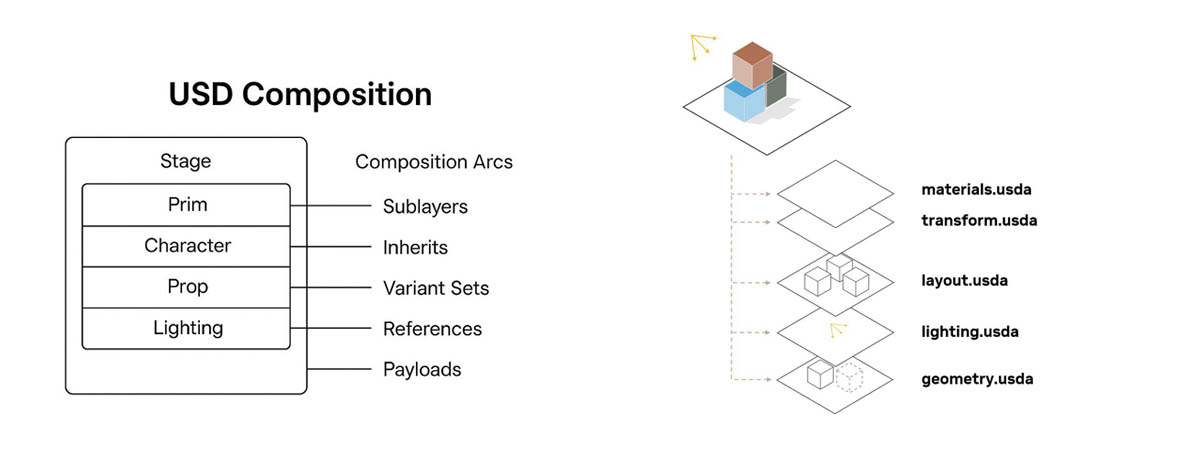
For example:
Base Environment
        ↓
Set Dressing
        ↓
Animation
        ↓
FX
        ↓
Lighting
        ↓
Shot Overrides
Each layer can contribute information without necessarily rewriting the layers beneath it.
This means the final scene is the result of composition, rather than simply the contents of one file.
That is a major conceptual shift.
Opinions, Overrides and Non-Destructive Workflows
This is where one of USD's most important characteristics becomes visible:
non-destructive editing.
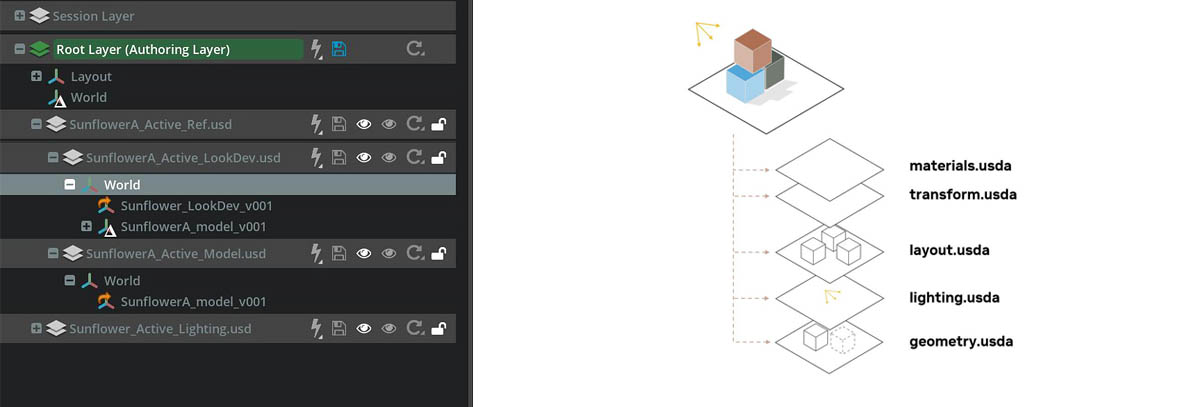
Suppose an environment department publishes:
environment_v05.usd
The lighting department needs to remove one light, change the position of another, and add production lighting.
Instead of modifying the original environment file, the lighting work can exist in a stronger layer.
Conceptually:
environment_v05.usd
        ↓
lighting.usd
        ↓
shot_010_lighting.usd
The original asset remains intact.
If a new environment version becomes available, the underlying contribution can potentially be replaced while higher-level overrides remain part of the composition.
SideFX explicitly describes this as one of the main benefits of the USD layer paradigm: a new layer can contain edits without affecting users of the original scene, while layers can be replaced and existing changes reapplied through composition.
This is why calling USD merely “non-destructive” is slightly incomplete.
Non-destructive editing is the result. Layered composition is one of the mechanisms that makes it possible.
References: Building Large Scenes From Smaller Pieces
USD references are another fundamental part of this architecture.
A USD scene can reference another USD asset and compose that asset into the current scene.
For example:
City.usd
│
├── Building_A
├── Building_B
├── Building_C
├── Vehicle_A
└── Character_A
The referenced assets do not have to be copied into the top-level scene.
Instead, the scene describes how those assets should be assembled.
This makes it possible to construct large environments from reusable components.
The distinction between references and sublayers is important: references compose another tree into a location in the scene, while sublayers overlay layer content into the current layer stack.
For artists, the practical result is simple:
a complex scene can be built from smaller, independently managed pieces.
Payloads: Don't Load the Entire World
Large scenes create another problem:
performance.
Imagine opening a digital city containing thousands of buildings, vehicles, characters and background assets.
You may need only a small section of that city for the shot you are working on.
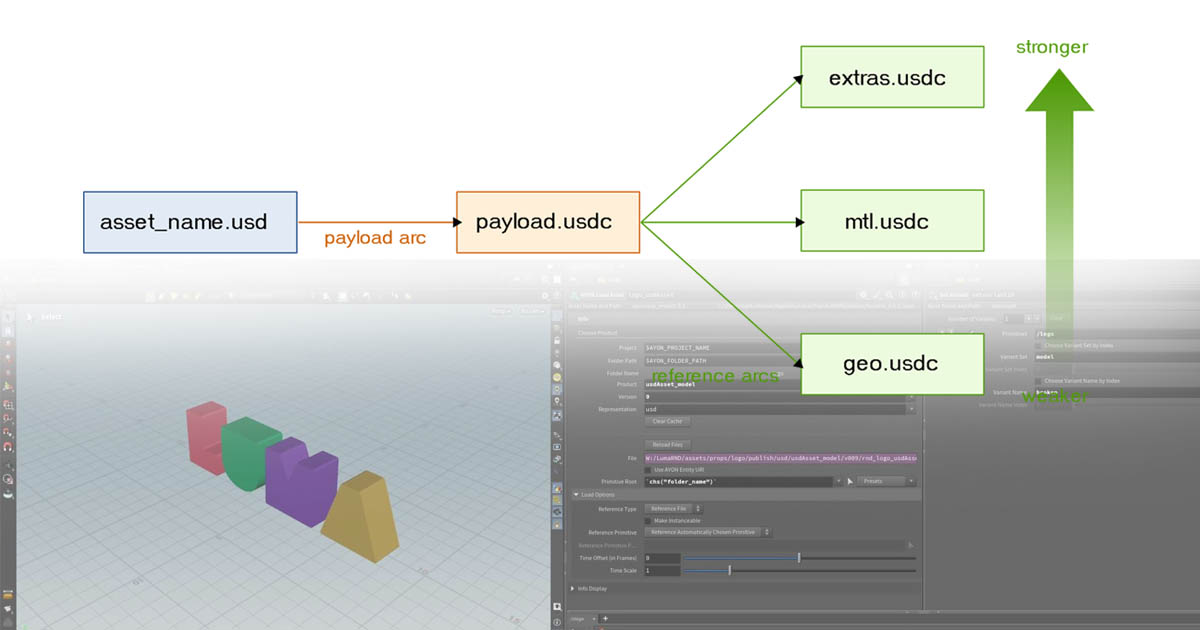
USD provides payloads, which can act as deferred references. Payload contents can be loaded or unloaded so that applications can control what becomes part of the working set.
Conceptually:
City
│
├── District A     [Loaded]
├── District B     [Loaded]
├── District C     [Unloaded]
├── District D     [Unloaded]
└── District E     [Unloaded]
This becomes especially important when scenes grow beyond what is practical to treat as one fully loaded dataset.
The idea is not merely “make the file smaller.”
Allow the production to describe a large world while giving each task a manageable working set.
That distinction matters.
Variants: One Asset, Multiple Possibilities
A production asset rarely exists in only one form.
A building may have:
-
damaged and clean versions
-
different levels of detail
-
different material states
-
multiple configurations
A character may have:
-
different costumes
-
facial variations
-
different body configurations
USD provides VariantSets for packaging variations into an asset and allowing downstream users to select among them.
For example:
Building
│
└── VariantSet: Damage
       ├── Clean
       ├── Damaged
       └── Destroyed
A downstream shot can select the required variation without having to create an entirely separate asset.
Again, the important idea is not simply convenience.
It is separating asset definition from shot-specific choice.
USD vs. Traditional Interchange Formats
USD is sometimes described as though it simply replaces formats such as FBX or Alembic.
That is too simplistic.
These formats solve different problems.
| Technology | Typical Strength |
|---|---|
| OBJ | Simple geometry interchange |
| FBX | Broad interchange of 3D scenes, models, animation and related data |
| Alembic | Efficient exchange of baked geometry and animation/cache data |
| USD | Scene description, composition, layering, references, variants and large-scale scene assembly |
Alembic, for example, is extremely useful for moving baked geometry and simulation caches.
FBX remains useful for interchange between many 3D applications.
USD's distinctive strength is the composition model around the data.
It can describe not only an object but also how objects, assets, layers and variations should be assembled into a larger scene.
That is why comparing USD to FBX or Alembic purely as “which format is better?” misses the point.
They can occupy different roles within the same pipeline.
In fact, USD can also work alongside other technologies rather than eliminating them. For example, Unreal's USD documentation describes support for USD plugins including Alembic, while Maya provides USD import/export workflows and support for USD sets and variants.
Asset Versioning and Shot-Specific Changes
Versioning is another area where USD becomes particularly interesting.
A VFX asset might progress through:
Character_v01
Character_v02
Character_v03
Character_v04
But a shot may not simply want “the latest version.”
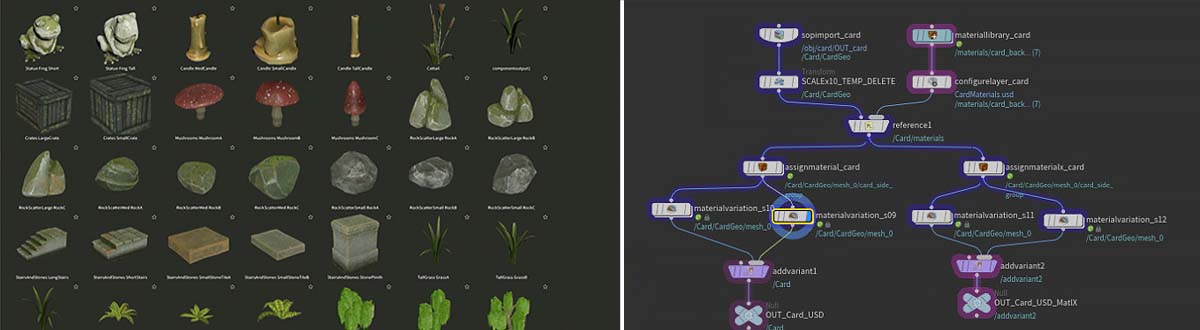
One shot may require the newest model.
Another may still depend on an older simulation.
A third may use a newer asset with a specific lighting or material override.
This is where USD's compositional structure can become useful.
An asset can be referenced as part of a larger scene while shot-specific changes live at a stronger level.
Conceptually:
Published Asset
       ↓
Asset Version
       ↓
Sequence / Environment
       ↓
Shot
       ↓
Shot-Specific Overrides
USD itself should not be confused with a version-control system. It does not magically solve asset publishing, approvals, dependency tracking or production databases.
What it does provide is a scene architecture in which different versions and layers can be composed without forcing every department to edit the same source data.
That architectural distinction is important for pipeline design.
Why This Matters to VFX Pipelines
Consider a simplified production.
Modeling
The modeling department publishes a character.
Look Development
Look development adds materials and appearance information.
Rigging and Animation
Animation works with the asset and publishes motion.
FX
FX adds destruction, particles, cloth or other simulations.
Layout
The character is placed into a shot.
Lighting
Lighting adds lights and shot-specific adjustments.
Rendering
The final composed scene is sent to a renderer.
Compositing
The resulting renders and scene data continue downstream.
In a traditional workflow, every stage may exchange files or caches.
With a USD-oriented architecture, the production can instead build a hierarchy of composed scene descriptions.
The exact implementation varies by studio and application, but the conceptual model is powerful:
Asset
   ↓
Assembly
   ↓
Shot
   ↓
Departmental Layers
   ↓
Final Composition
Each department can contribute without necessarily destroying the underlying work of another department.
This is one of the reasons USD is particularly relevant to modern pipeline engineering.
Solaris: USD Inside Houdini
If you use Houdini, the most visible implementation of this philosophy is Solaris.
Solaris is Houdini's scene-building, look-development and Karma-rendering environment built around USD. Its LOP networks operate on USD scenes rather than Houdini's traditional SOP geometry model.
This is why Solaris can initially feel different from traditional Houdini workflows.
In SOPs, you primarily think about geometry.
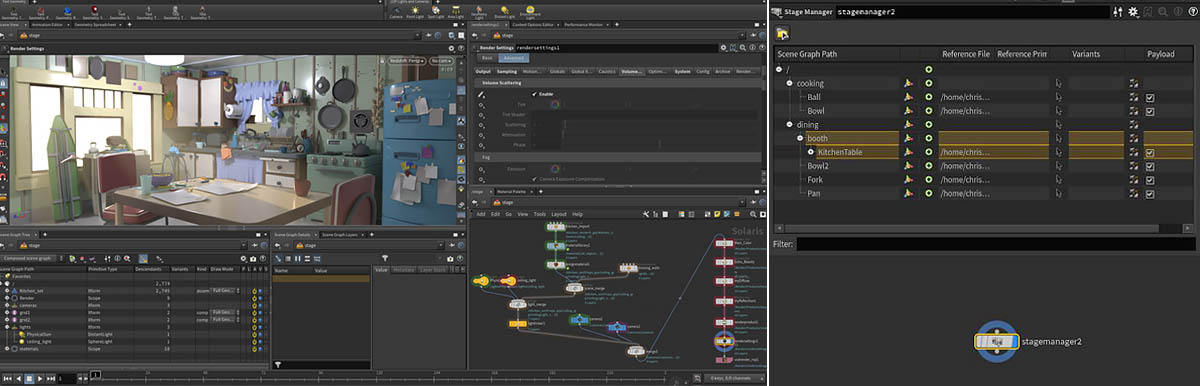
In Solaris, you start thinking about:
-
stages
-
layers
-
prims
-
references
-
variants
-
payloads
-
composition
-
scene graphs
-
overrides
SideFX describes LOPs as networks that generate or modify USD, with edits generally being written into stronger layers rather than directly modifying loaded layers from disk.
That is the practical expression of the non-destructive philosophy we discussed earlier.
The Procedural Advantage of Solaris
USD itself is primarily a scene description system.
Solaris adds Houdini's procedural approach on top of it.
That distinction is important.
SideFX explains that LOP networks can generate USD dynamically and procedurally. A network can, for example, generate repeated structures, modify a scene based on expressions or other inputs, and package procedural operations into reusable tools.
This creates an interesting combination:
USD provides the scene architecture.
Houdini provides procedural scene construction.
Together, they allow artists and technical directors to build complex scenes while retaining a structured representation of the result.
This is one reason Solaris is much more than simply “Houdini's lighting workspace.”
It is effectively Houdini's interface to a USD-centered way of thinking about scenes.
USD Is Bigger Than Solaris
It is important not to confuse USD with Solaris.
Solaris is SideFX's USD-based environment.
USD itself is an open-source technology that can be used across different applications and pipelines.
Maya, for example, provides USD import/export workflows and supports concepts such as USD sets and variants.
Unreal Engine also provides USD workflows through its USD Stage system, including scene hierarchy, variants, payload loading/unloading and non-destructive attribute editing.
This broader ecosystem is important.
If USD were simply a Houdini technology, its importance would be much more limited.
Its real significance comes from the possibility of using a common scene-description architecture across multiple parts of a production ecosystem.
USD and the Broader VFX Ecosystem
The movement toward USD is also visible beyond individual applications.
The Academy Software Foundation hosts a USD Working Group focused on advancing USD-related technology and practices across the industry. The broader USD ecosystem also includes work around areas such as materials, cameras, games and web workflows.
This does not mean every studio has suddenly converted its entire pipeline to USD.
VFX pipelines are rarely that simple.
Studios have years of internal tools, proprietary systems, asset databases, render infrastructure and established interchange formats.
Instead, USD is increasingly appearing as a scene-assembly and pipeline layer alongside existing technologies.
That is a much more realistic way to understand its adoption.
What USD Does Not Solve
USD is powerful, but it is not a magic solution for every pipeline problem.
It does not automatically solve:
-
asset naming
-
production tracking
-
version-control policies
-
bad asset structure
-
dependency management
-
color-management problems
-
broken texture paths
-
poor pipeline design
-
inconsistent studio standards
-
application-specific limitations
A poorly designed USD pipeline can still be a poorly designed pipeline.
There is also a learning curve.
USD introduces concepts such as:
-
composition arcs
-
opinions
-
layers
-
prims
-
references
-
payloads
-
variants
-
namespaces
-
asset resolution
For artists coming from traditional DCC workflows, this vocabulary can initially feel abstract.
The complexity is partly a reflection of what USD is trying to represent.
A simple scene can remain simple.
But a system capable of describing a huge production scene inevitably requires more concepts than a simple geometry file.
Is USD Really Becoming the Language of Modern VFX?
The phrase “language of modern VFX” should not be interpreted literally.
USD is not replacing every existing format.
Nor does every VFX studio use USD in exactly the same way.
But the metaphor becomes useful when we look at what USD provides.
A language defines a way of describing things and relationships.
USD provides a structured way to describe:
-
assets
-
scenes
-
hierarchy
-
relationships
-
variations
-
layers
-
overrides
-
composition
And increasingly, different applications can interact with that description.
That is why USD can function as something more significant than an interchange format.
It can become a common scene vocabulary between different parts of a pipeline.
The growing support around Houdini/Solaris, Maya, Unreal and the wider USD ecosystem makes this direction increasingly visible.
But the important point is not the number of applications that can open a .usd file.
The deeper point is that these applications can participate in a common scene-composition model.
The Bigger Shift
The most important change USD introduces may have little to do with the file extension itself.
It is a change in how we think about digital scenes.
The traditional mental model is:
The scene is a file.
The USD mental model is closer to:
The scene is a composition of data.
That difference has major consequences.
A scene can be assembled from independent assets.
Assets can contain variations.
Layers can represent departmental contributions.
Shot-specific changes can exist above published data.
Large components can be loaded selectively.
And the final scene can be the result of composition rather than the result of repeatedly modifying one master file.
This is particularly well suited to VFX because VFX is fundamentally an iterative discipline.
A shot changes.
An asset changes.
A simulation changes.
A lighting decision changes.
A director changes their mind.
A new version arrives.
The pipeline therefore needs to preserve previous work while allowing new decisions to be layered on top.
That is precisely the kind of problem USD's composition model is designed to address.
Conclusion: USD Is About More Than Interchange
USD's importance is easy to misunderstand if it is introduced simply as “a new 3D file format.”
That description misses its most interesting feature.
USD provides a framework for describing, composing, overriding and organizing complex scenes.
Layers make contributions separable.
References make assets reusable.
Payloads help manage large working sets.
Variants allow assets to contain multiple possibilities.
Composition allows those pieces to become a larger scene without requiring everything to be flattened into one file.
And applications such as Houdini Solaris, Maya and Unreal demonstrate how that scene description can become part of different production workflows.
The long-term significance of USD, therefore, may not be that it replaces FBX, Alembic or every other format.
Its significance is that it offers a different answer to a much larger problem:
How do you build and manage a complex digital world when dozens of artists, departments, applications and versions need to work on it without constantly destroying each other's work?
That is a pipeline problem.
And USD is increasingly becoming one of the technologies designed to solve it.
 References & Further Reading

Sadjad Jahangiri 





Add comment