
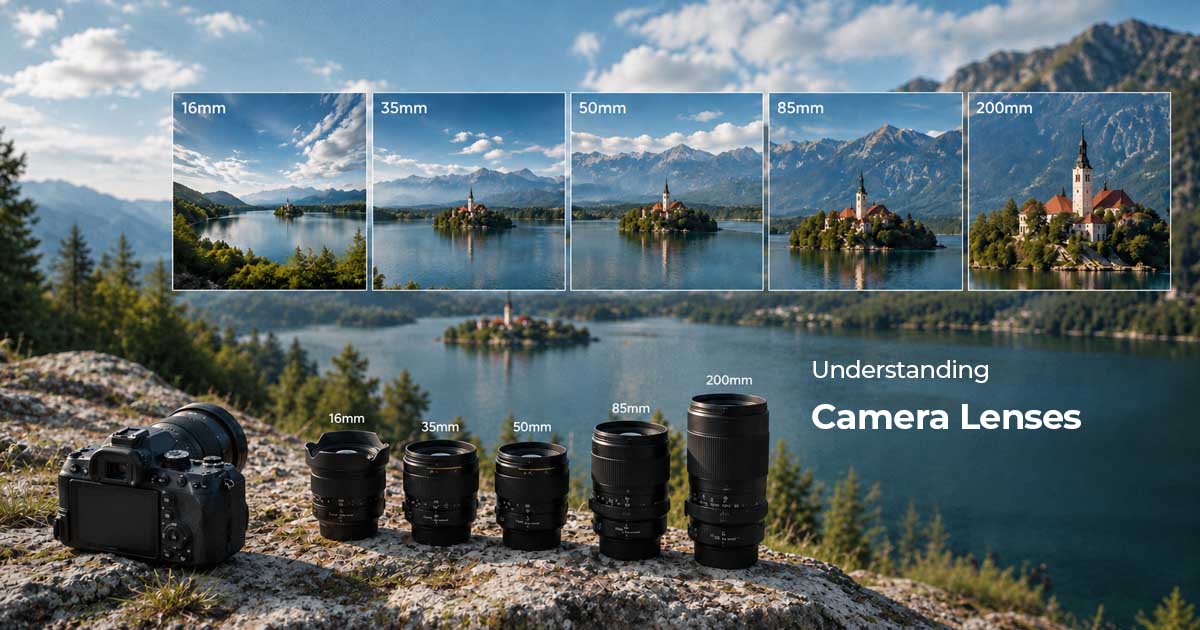
A camera lens is far more than a piece of glass that makes an image look closer or wider.
A lens is part of the optical system that determines how the three-dimensional world is projected onto a two-dimensional imaging plane. Its focal length affects the angle of view and magnification, while its optical design influences characteristics such as distortion, chromatic aberration, vignetting, and the rendering of out-of-focus areas.
For photographers and cinematographers, understanding these relationships provides greater control over composition and visual storytelling.
For VFX artists, the same knowledge becomes part of the technical foundation of camera reconstruction, matchmoving, and image integration.
The important point is that these properties should not be considered independently.
Focal length, sensor size, camera position, focus distance, aperture, and lens design all interact to determine the resulting image.
1. What Does a Camera Lens Actually Do?
At its simplest, a camera lens collects light from a scene and forms an optical image on the camera's imaging plane.
The imaging process can be simplified as:
Scene → Lens → Optical Projection → Sensor → Image Data
The lens controls how rays of light from different parts of the scene are projected onto the sensor.
A lens has many characteristics that influence the resulting image, including:
- Focal length
- Maximum aperture
- Angle of view
- Focus range
- Depth-of-field behavior
- Distortion
- Chromatic aberration
- Vignetting
- Bokeh characteristics
A real photographic or cinema lens is also a complex optical system made from multiple elements designed to control the path of light while minimizing or deliberately shaping optical aberrations.
This is why two lenses with identical focal-length and aperture specifications can still produce noticeably different images.
The numbers on the lens describe important capabilities, but they do not completely describe the lens's visual character.
2. Focal Length: More Than a Number
Focal length is one of the fundamental specifications of a lens and is normally expressed in millimeters.
In simplified optical terms, it describes a fundamental property of the lens system that determines how the scene is projected onto the image plane. Under the conventional definition, focal length is measured with the lens focused at infinity.
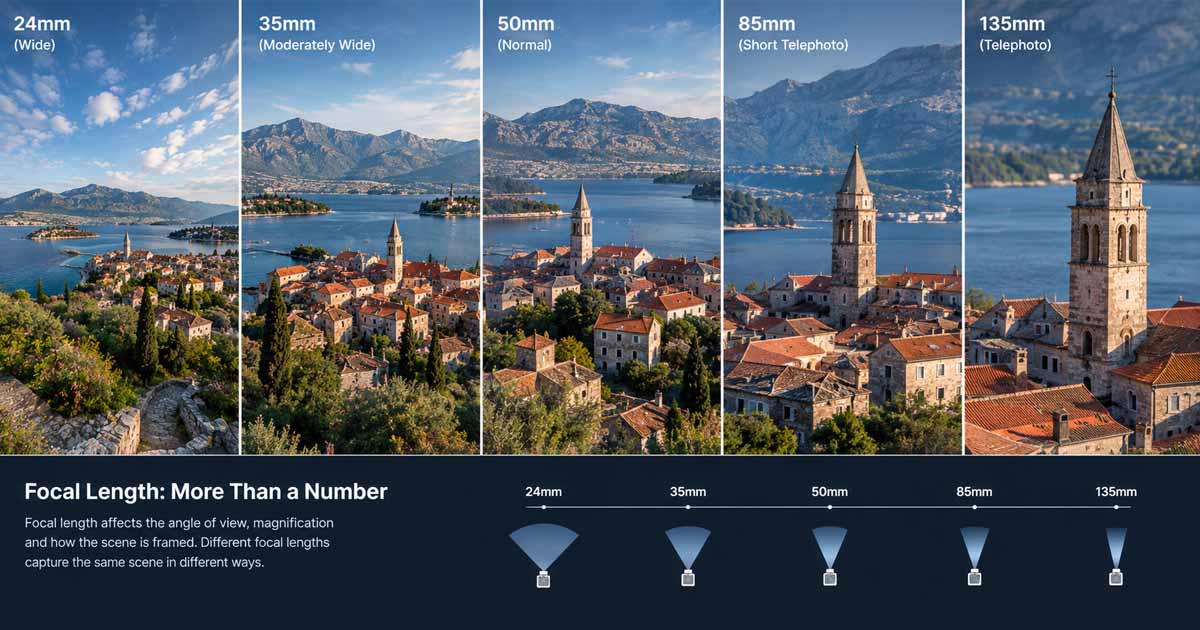
In practical photography and cinematography, focal length provides an indication of the lens's angle of view and magnification for a particular sensor format.
A shorter focal length generally provides a wider angle of view.
A longer focal length provides a narrower angle of view and greater image magnification.
For example:
- 24mm — wide
- 35mm — moderately wide
- 50mm — normal on a full-frame/35mm format
- 85mm — short telephoto
- 135mm — longer telephoto
These classifications are conventions rather than strict physical categories. A lens's practical field of view always depends on the imaging format it is used with.
So saying that a lens is simply "wide" or "telephoto" without specifying the camera format can be incomplete.
3. Focal Length and Field of View
Field of view describes how much of the scene is visible through the camera.
It depends primarily on two things:
Focal length + sensor dimensions
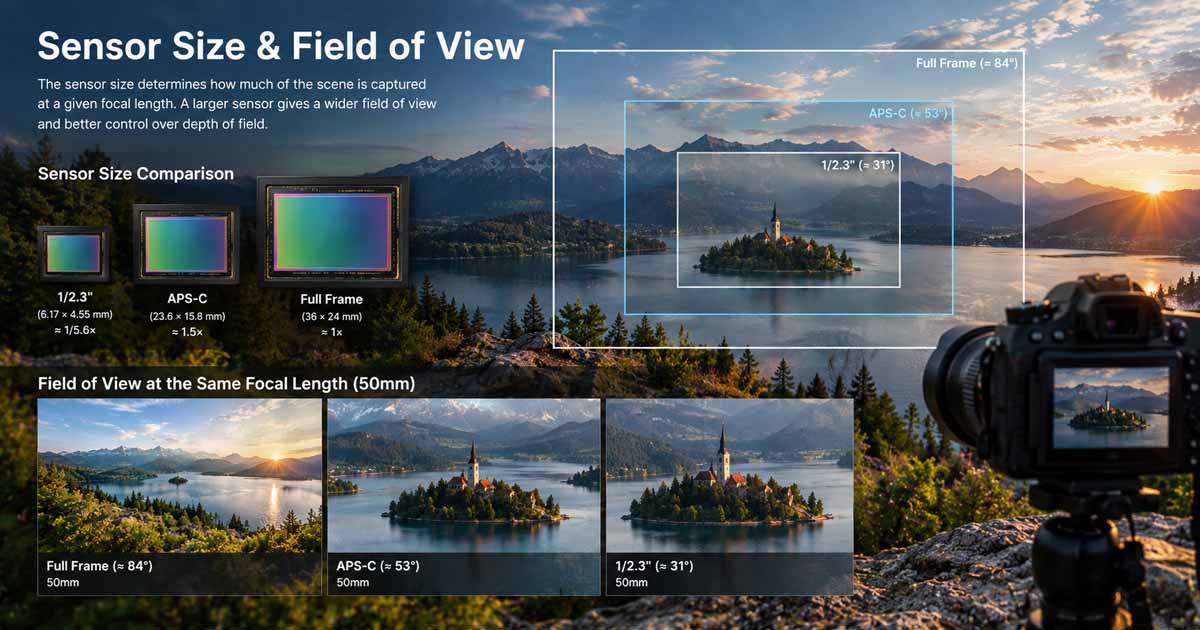
For a given sensor format, a shorter focal length produces a wider field of view, while a longer focal length produces a narrower field of view.
But sensor dimensions matter just as much.
Consider a 50mm lens.
A 50mm lens used on a full-frame sensor does not produce exactly the same framing as a 50mm lens used on a Super 35 or APS-C sensor.
The physical focal length has not changed.
The portion of the image captured by the sensor has changed.
This is the basis of concepts such as crop factor and equivalent focal length.
However, when working in cinematography and especially VFX, it is often more useful to work with the actual focal length and actual sensor or film-back dimensions rather than relying only on an equivalent focal length.
A simplified relationship is:
Focal Length + Sensor Dimensions → Field of View
This relationship becomes particularly important when recreating a real camera in a 3D application.
4. Focal Length Does Not Create Perspective
This is one of the most important—and most frequently misunderstood—concepts in photography.
It is common to hear statements such as:
"Wide-angle lenses exaggerate perspective."
or:
"Telephoto lenses compress perspective."
These descriptions can be useful when talking about the appearance of an image, but technically they are incomplete.
Perspective is determined by the camera's position relative to the scene.
Imagine a camera positioned three meters from a subject.
If we replace a 35mm lens with an 85mm lens without moving the camera, the subject becomes larger in the frame and the field of view becomes narrower.
But the actual perspective relationship between the subject and background has not changed.
The camera is still in exactly the same place.
The 85mm lens is simply showing a smaller portion of the same scene.
This distinction is fundamental to understanding how lenses work.
5. Same Camera Position vs. Same Framing
The easiest way to understand perspective is to compare two different situations.
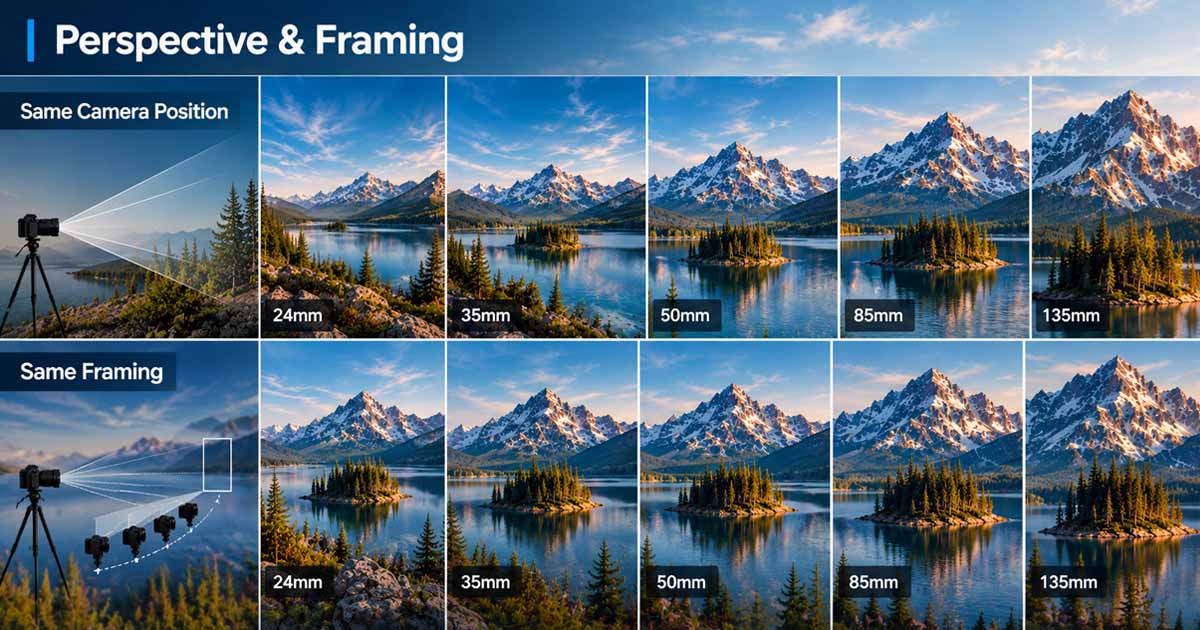
Same Camera Position
Imagine a subject standing in front of a building.
The camera is three meters from the subject.
First, we shoot with a 35mm lens.
Then we switch to an 85mm lens without moving the camera.
The 85mm image is tighter.
The subject appears larger.
The field of view is narrower.
But the spatial relationship between the subject and the building remains the same because the camera has not moved.
Same Framing
Now imagine that we want the subject to occupy exactly the same amount of the frame in both shots.
With the 35mm lens, the camera can remain relatively close.
With the 85mm lens, the camera must move farther away to maintain the same framing.
Now something important has changed:
The camera position.
Because the camera moved, the perspective changed.
The relationship between the foreground subject and the distant background is now different.
This is the real reason that images captured from farther away with longer focal lengths can appear visually compressed.
6. Perspective Compression: What Is Actually Happening?
The term perspective compression is widely used in photography and cinematography.
However, the lens itself does not contain a mechanism that physically compresses space.
The apparent compression comes from the camera position used to achieve the desired framing.
A telephoto lens makes it possible to frame a subject from a greater distance.
When the camera moves farther away, the relative difference in distance between foreground and background objects becomes smaller from the camera's viewpoint.
As a result, distant objects can appear closer in size and spatial relationship to the foreground subject.
This produces the familiar "compressed" or "flattened" appearance associated with long-lens photography.
So a more technically accurate statement is:
Long focal lengths are often associated with compressed-looking images because they are commonly used from greater camera-to-subject distances.
This distinction is especially important in VFX.
If a virtual camera is given the correct focal length but placed in the wrong position, the resulting projection can still be incorrect.
7. Depth of Field: What Determines What Stays in Focus?
Depth of field (DoF) describes the range around the plane of focus that appears acceptably sharp.
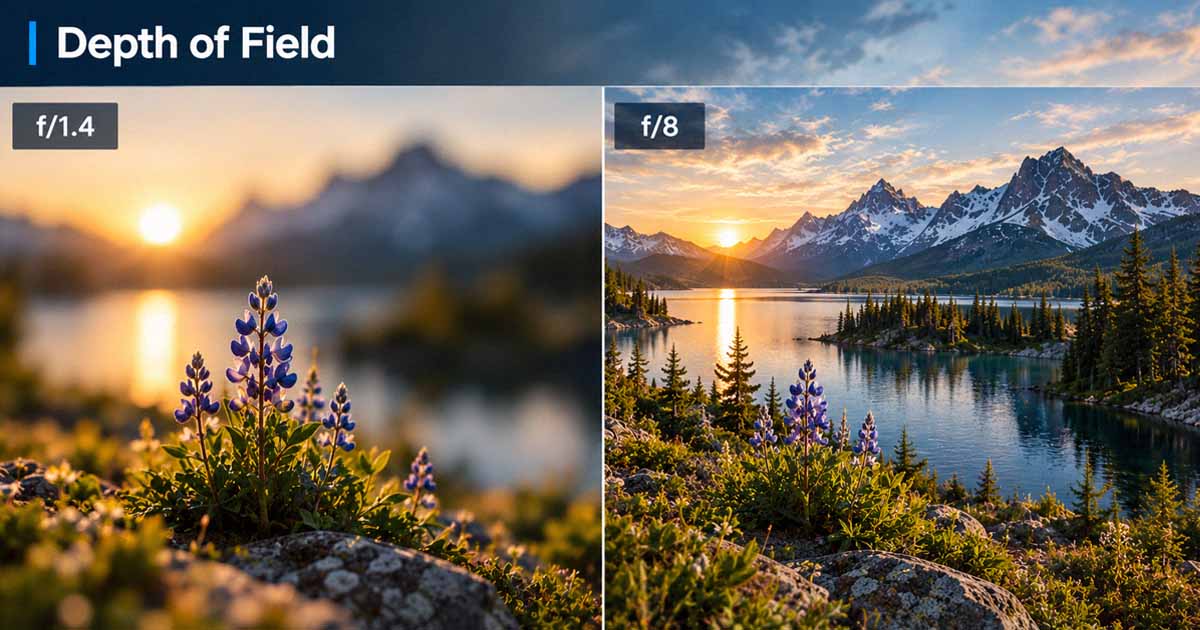
It is influenced by several variables, including:
- Aperture
- Focus distance
- Focal length
- Sensor or image format
- Circle of confusion
- Image magnification
- Viewing conditions
Aperture is one of the most obvious controls.
A large aperture, represented by a small f-number such as f/1.4, generally produces a shallower depth of field.
Stopping the lens down to f/8, for example, generally increases the depth of field.
But aperture is only one part of the equation.
Focus distance can have a major effect as well.
As the camera focuses closer to the subject, the depth of field becomes progressively shallower.
This is why macro photography can produce extremely shallow focus even when the aperture is not exceptionally wide.
8. The Same-Framing Depth-of-Field Problem
One of the reasons discussions about depth of field can become confusing is that different comparisons produce different results.
Consider two cameras producing approximately the same framing of a subject.
Camera A
- 35mm lens
- Camera relatively close to the subject
- f/2.8
Camera B
- 85mm lens
- Camera farther from the subject
- f/2.8
Both images can have similar subject framing.
But several variables have changed:
- Focal length
- Camera-to-subject distance
- Magnification
- Background reproduction
- Field of view
Therefore, it is not technically sufficient to say:
"An 85mm lens always produces shallower depth of field than a 35mm lens."
The result depends on what conditions are being held constant.
Are we keeping the:
- Camera position constant?
- Subject framing constant?
- Subject magnification constant?
- Aperture constant?
- Sensor format constant?
Without specifying these conditions, comparisons can be misleading.
A more useful way to think about depth of field is as the result of several interacting variables rather than a property controlled by focal length alone.
9. Aperture, Focus Distance, and Depth of Field
At a given focal length and focus distance, opening the aperture generally reduces depth of field.
Closing the aperture generally increases it.
Focus distance is equally important.
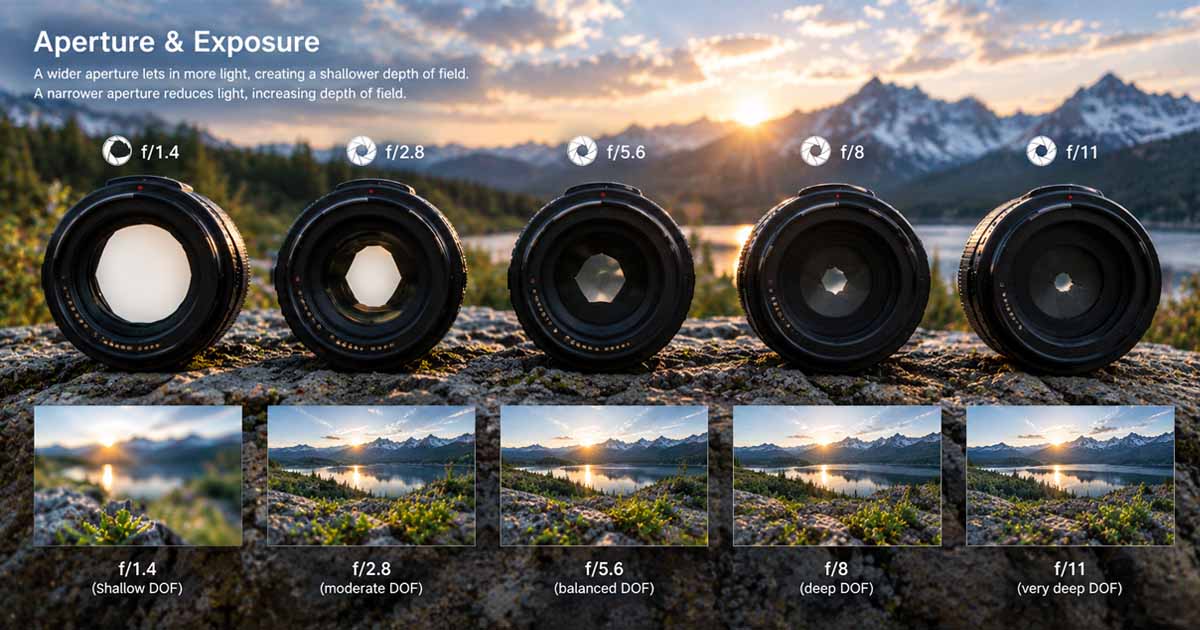
As the camera moves closer to the subject, depth of field decreases.
This is particularly obvious in close-up and macro photography.
A useful conceptual model is:
Depth of Field = Aperture + Focal Length + Focus Distance + Format + Viewing Conditions
This is not a mathematical formula, but a way to understand why changing a single camera setting does not always produce the same visual result in every situation.
For VFX artists, the distinction is particularly important.
A 3D camera can reproduce the same nominal f-number while still producing an incorrect result if its focal length, sensor dimensions, focus distance, or camera position do not match the original camera.
10. Sensor Size and Depth of Field
Sensor size is another subject that is often oversimplified.
It is common to hear that:
"A larger sensor gives shallower depth of field."
That statement is incomplete.
Sensor size does not act as a simple independent depth-of-field control.
Its significance becomes clearer when comparing different camera formats under equivalent framing conditions.
Suppose we want the same composition on two different sensor formats.
We may need to use different focal lengths to achieve the same field of view.
We may also need to change camera position depending on the desired framing.
Those changes affect magnification, focal length, and depth-of-field behavior.
Therefore, when comparing sensor formats, it is more useful to ask:
What exactly are we keeping constant?
- Same framing?
- Same camera position?
- Same field of view?
- Same aperture?
- Same subject distance?
Once these conditions are defined, the comparison becomes meaningful.
This is particularly important when comparing full-frame, Super 35, APS-C, Micro Four Thirds, and larger cinema formats.
11. Bokeh Is Not the Same as Depth of Field
Depth of field tells us how much of the scene appears acceptably sharp.
Bokeh describes the visual character of areas that are out of focus.
Two lenses can produce a similar depth of field while rendering their out-of-focus regions differently.

Bokeh can be influenced by:
- Aperture shape
- Number and shape of aperture blades
- Optical design
- Spherical aberration
- Focus distance
- Background structure
- Lens construction
This is why two lenses with identical focal length and maximum aperture can still produce noticeably different-looking images.
One may produce smooth, soft highlights.
Another may produce more defined or distinctive shapes.
The specification sheet tells us what the lens is capable of.
The optical design determines much of how that capability is rendered.
12. Lens Distortion and Optical Characteristics
Real lenses are not mathematically perfect imaging systems.
They introduce optical characteristics that can become visible in the final image.
Barrel Distortion
Straight lines can curve outward, particularly toward the edges of the frame.
This behavior is commonly associated with many wide-angle designs.
Pincushion Distortion
Straight lines can curve inward.
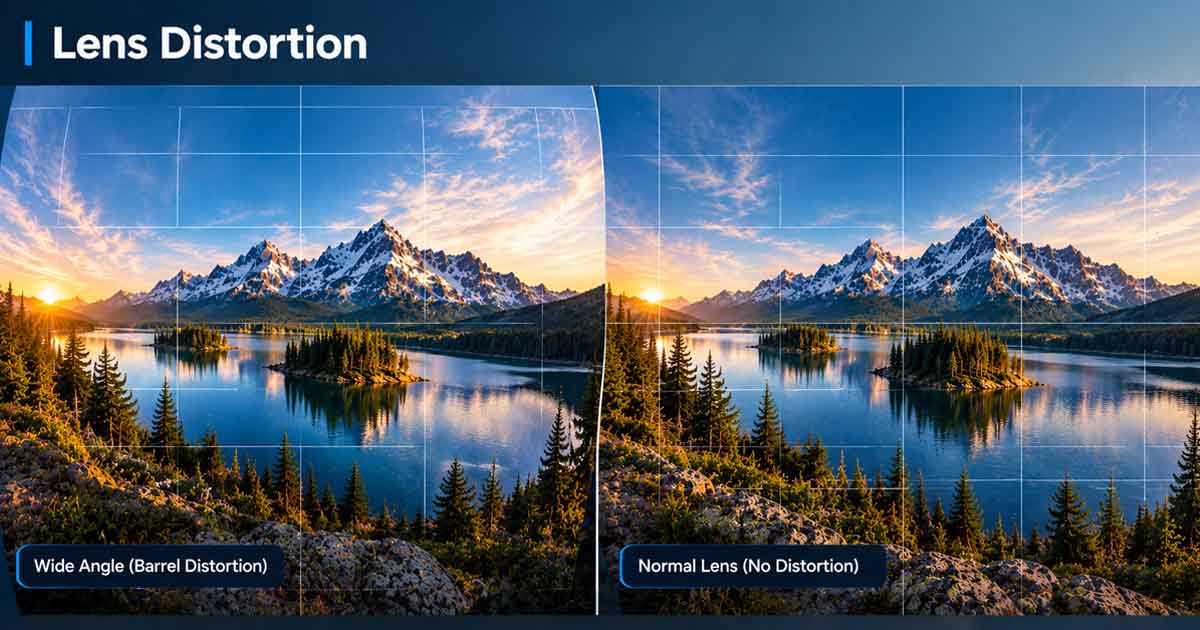
This behavior is often encountered toward the telephoto end of certain optical designs and zoom lenses.
Complex Distortion
Some lenses can exhibit more complicated combinations of distortion, sometimes producing a shape commonly described as mustache or wave distortion.
Chromatic Aberration
Different wavelengths of light can be refracted differently, producing color fringing around high-contrast edges.
Vignetting
The edges of the image can become darker than the center.
Focus Breathing
The apparent framing or angle of view can change as the lens is focused.
Focus breathing can be particularly noticeable during cinematic focus pulls.
These characteristics may be subtle in normal photography, but they can become highly relevant in VFX.
A perfectly clean mathematical camera does not necessarily reproduce the behavior of a real photographic lens.
13. Prime vs. Zoom Lenses
A prime lens has a fixed focal length.
A zoom lens provides a variable focal-length range.
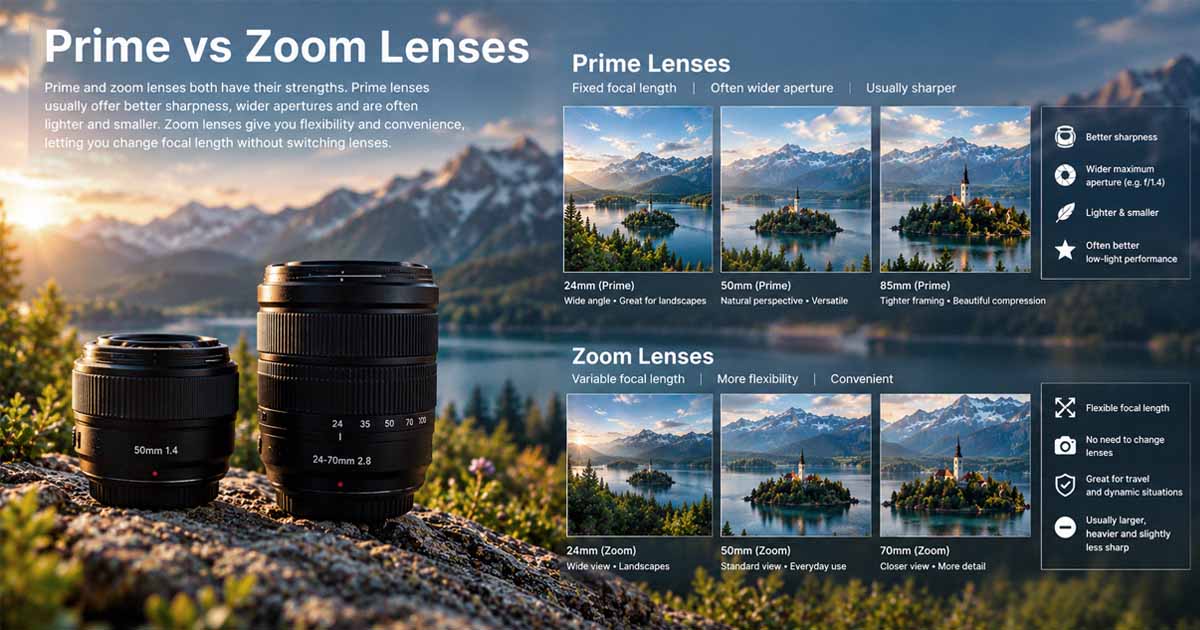
Prime lenses can offer advantages such as:
- Wide maximum apertures
- Specialized optical designs
- Consistent focal-length behavior
- Distinctive optical characteristics
Zoom lenses provide:
- Flexible framing
- Multiple focal lengths
- Fewer lens changes during production
- Greater operational versatility
A wide maximum aperture, however, is not an inherent property of prime lenses.
It is simply a characteristic that prime lens designs can often provide more easily than comparable zoom designs.
The choice between prime and zoom therefore depends on the production requirements, desired optical behavior, shooting conditions, and workflow.
14. Choosing a Lens for Cinematic Images
There is no universally correct focal length.
The right lens depends on what the filmmaker or photographer wants the image to communicate.
Wide-Angle Lenses
Wide lenses can emphasize:
- Spatial depth
- Foreground objects
- Environmental scale
- Camera movement
- The relationship between a subject and its surroundings
They can be particularly effective when the camera needs to operate close to a subject.
Normal Lenses
Normal lenses can provide a relatively balanced relationship between subject and environment.
They are often useful when the goal is to avoid strongly exaggerated wide-angle or telephoto characteristics.
Telephoto Lenses
Longer lenses can provide:
- Narrower fields of view
- Greater working distance
- Subject isolation
- Compressed-looking spatial relationships
The important thing is not to think of a focal length as having a single "look."
The final image results from the interaction between:
Lens + Camera Position + Sensor Format + Subject Distance + Lighting + Scene Geometry
15. Why Lens Characteristics Matter in VFX
In a VFX shot, the camera is not simply a viewpoint.
It is part of the mathematical relationship that projects the three-dimensional world onto a two-dimensional image.
Suppose a live-action plate contains a person standing in front of a building.
A CG object needs to be inserted into that scene.
If the virtual camera uses the wrong focal length, sensor dimensions, camera position, or lens distortion, the CG object may not maintain the correct relationship with the photographed environment.
The model may be perfectly built.
The texture may be correct.
The lighting may be convincing.
And yet the object can still look like it does not belong in the shot.
This is one of the reasons camera reconstruction is so important in visual effects.
16. Camera Matching: Reconstructing the Original Imaging System
Camera matching attempts to reproduce the projection of the original camera inside a digital environment.
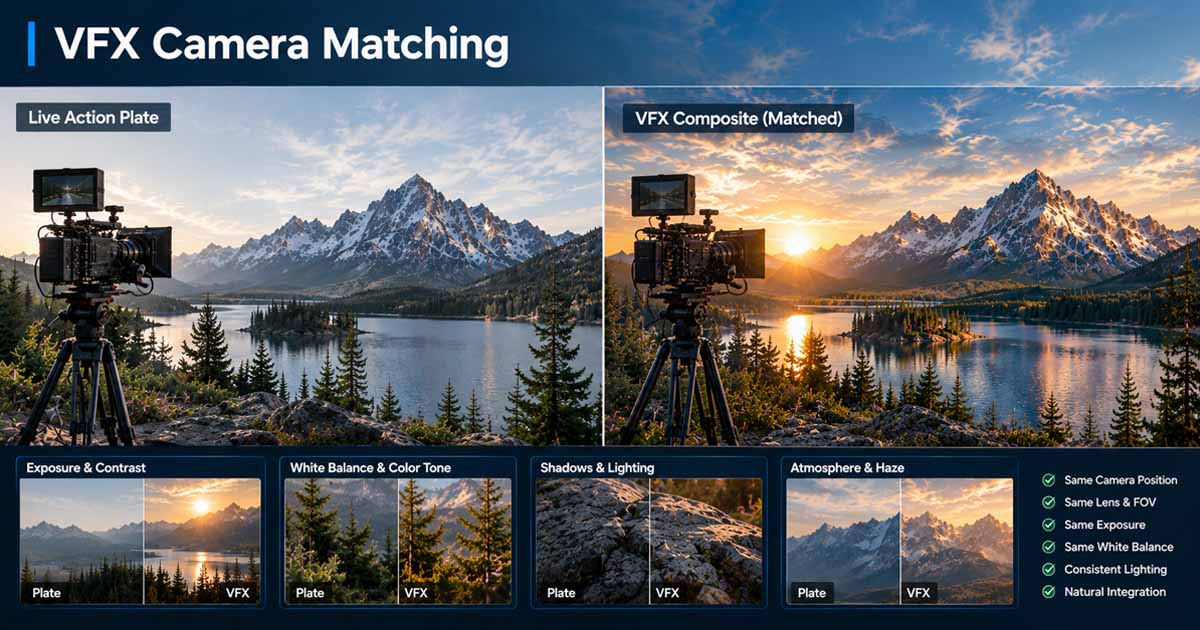
Depending on the shot and production workflow, the VFX team may need to determine:
- Camera position
- Camera orientation
- Sensor or film-back dimensions
- Focal length
- Focus distance
- Lens distortion
- Lens breathing
- Other lens-specific characteristics
A simplified representation is:
Camera Position + Camera Orientation + Sensor/Filmback + Lens Parameters + Distortion
The objective is not simply to find a focal-length number that makes the frame look approximately correct.
The goal is to reproduce the imaging system that created the original plate.
This is why production data can be extremely valuable.
Modern cinema-camera systems can record lens metadata such as focal length, focus distance, iris, and lens identification. That information can be passed into post-production and VFX workflows, reducing the amount of information that artists have to reconstruct manually.
For complex shots, accurate lens information can save significant time and reduce uncertainty.
17. Why Lens Metadata Matters
Imagine a production shooting a VFX-heavy sequence.
The camera system records:
- Lens model
- Focal length
- Focus distance
- Iris
- Camera data
- Lens identification
Instead of relying entirely on visual estimation later, the VFX team can use this information as part of the reconstruction process.
This does not eliminate the need for tracking or lens analysis.
Real-world production still involves calibration, distortion analysis, tracking errors, changing lenses, focus pulls, and other variables.
But reliable metadata provides a valuable starting point.
This is a good example of how cinematography and VFX are increasingly connected through data.
The lens is no longer just an optical component.
It can also become a source of production metadata.
18. From Photography to Digital Cinematography
Understanding lenses becomes even more important as modern image-making workflows become increasingly digital.
A contemporary production may involve:
Camera → Lens → Sensor → RAW/Log → Color Management → VFX → Compositing → Final Image
At every stage, information about the original camera and lens can affect how the image is interpreted.
A VFX artist working in a 3D environment is therefore not simply creating a virtual scene.
They are reconstructing the conditions under which the original image was captured.
This is why concepts that may initially appear to belong exclusively to photography—such as focal length, field of view, depth of field, distortion, and focus distance—are also fundamental VFX concepts.
19. The Lens Is Part of the Image
A camera system is not simply a sensor that records whatever appears in front of it.
The final image is produced through the interaction of:
Scene + Lighting + Camera Position + Lens + Sensor + Image Processing
Focal length influences the field of view.
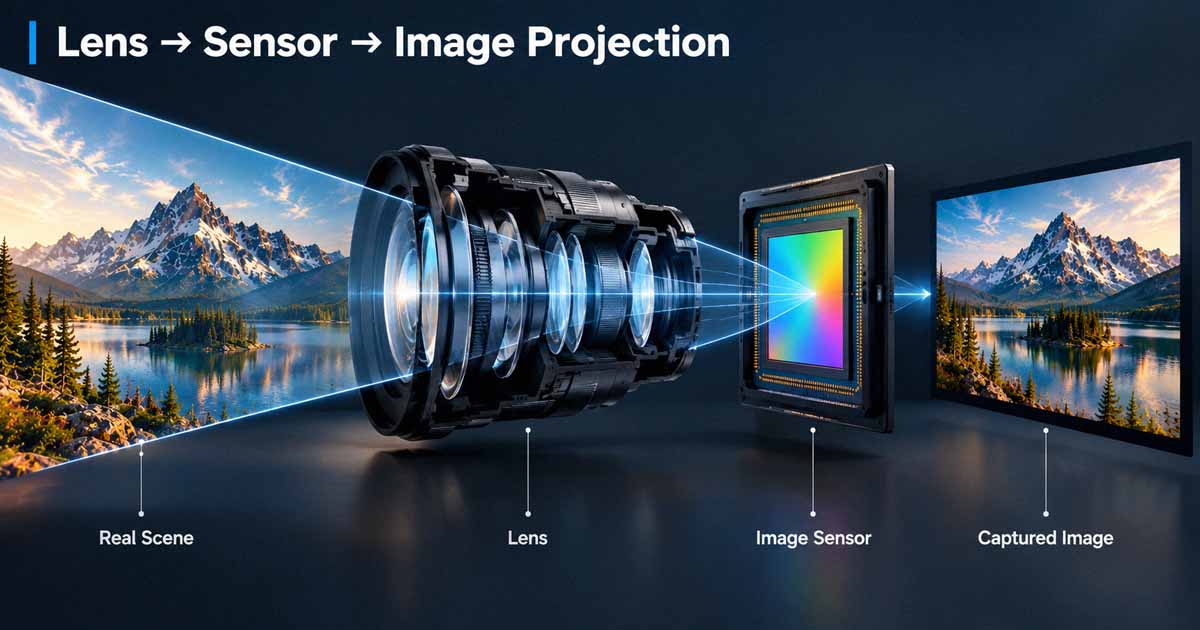
Sensor dimensions influence the portion of the projected image that is captured.
Camera position determines perspective.
Aperture influences exposure and depth of field.
Focus distance changes the region of acceptable sharpness.
Optical design influences distortion, aberrations, vignetting, and bokeh.
Together, these properties form a significant part of the visual language of photography and cinematography.
For VFX artists, understanding these relationships provides something even more valuable: the ability to reason backward from an image and understand how that image could have been created.
That is ultimately what camera matching is about.
Not simply matching a focal-length number.
Reconstructing the imaging system behind the shot.
Conclusion
Understanding camera lenses begins with a simple idea:
A lens does not simply zoom the world in or out. It controls how the three-dimensional world is projected onto the camera's imaging plane.
Focal length and sensor dimensions determine the field of view.
Camera position determines perspective.
Aperture and focus distance strongly influence depth of field.
Lens design determines many of the optical characteristics that give an image its visual personality.
Once these relationships become clear, choosing a lens becomes much more than selecting a focal-length number.
For photographers, it provides greater control over composition.
For cinematographers, it becomes a tool for visual storytelling.
And for VFX artists, it becomes part of the technical foundation required to reconstruct a real camera inside a digital environment.
The better we understand how the original image was formed, the more accurately we can recreate it.
The lens is not just a piece of glass. It is part of the system that shapes how we see the world.
 References & Further Reading

Sadjad Jahangiri 




Add comment