
.Today, we’re diving into another fascinating and important topic: a revolutionary technology from ILM called StageCraft, which is being used in major film projects around the world. In this article, we’ll take a detailed look at how it works so stay with me.
StageCraft, also known as LED Volume, is a groundbreaking innovation in the world of visual effects, developed by ILM, one of the most advanced VFX studios globally. It was specifically designed for real-time filming of virtual environments.
If we were to highlight a key figure behind this technology, it would be John Knoll, one of ILM’s most creative and innovative engineers. Together with his team at ILM, he helped develop StageCraft to create virtual environments and visual effects in real-world filming without the need for traditional green screens.
As a result, StageCraft has become a major innovation in film and television production. This technology allows filmmakers to combine real and virtual scenes using large LED panels and 360-degree environments, enabling faster production and reduced costs.
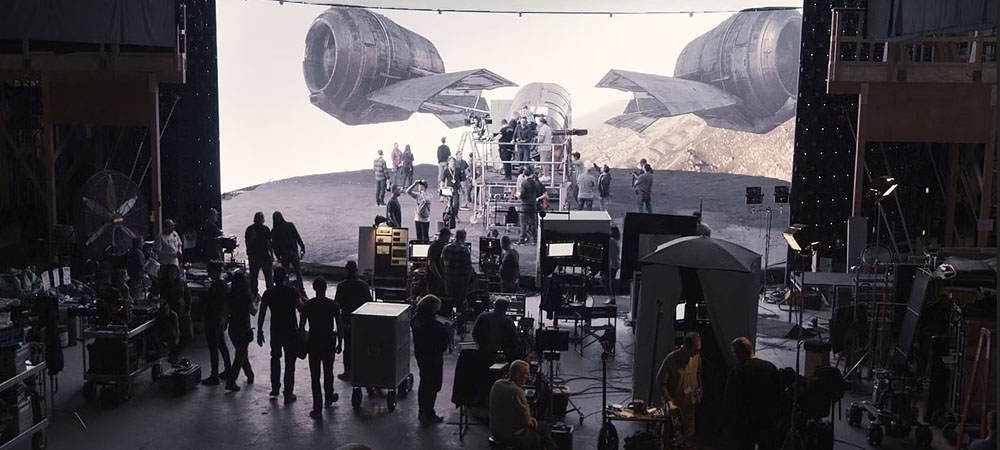
Since 2019, StageCraft has been widely adopted in the film and television industry. It was developed by a team of engineers and VFX specialists at ILM, in collaboration with technology partners such as Epic Games (the creators of Unreal Engine), which helps generate the virtual environments used in this system.
Instead of relying on green screens for visual effects in post-production, StageCraft uses large LED panels to display digital scenes and environments in real time during filming. This LED Volume technology has been especially prominent in producing visual effects for the Star Wars films.
While StageCraft was officially launched in 2020, its development and testing began earlier. ILM created it specifically for film and television production, experimenting with virtual studios and LED walls prior to its commercial release.
In this method, large, high-resolution displays are used as dynamic digital backgrounds, allowing filmmakers to create more realistic environments and helping actors perform naturally within a virtual world. These LED walls can simulate real-world environments, from natural landscapes to urban settings, giving performers the sense of actually being within the scene.
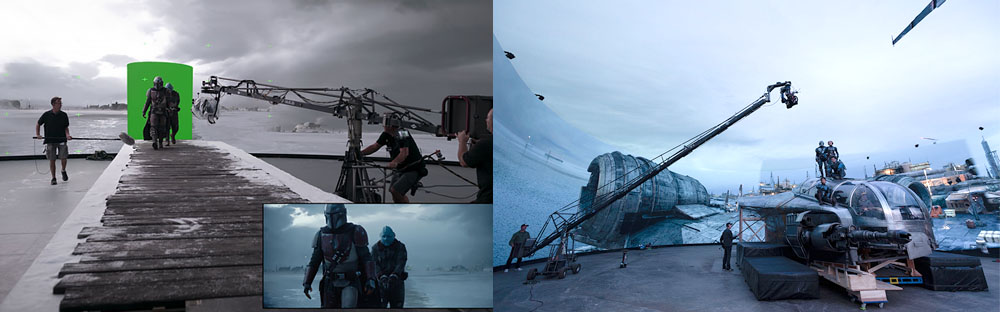
How LED Volume / StageCraft Technology Works
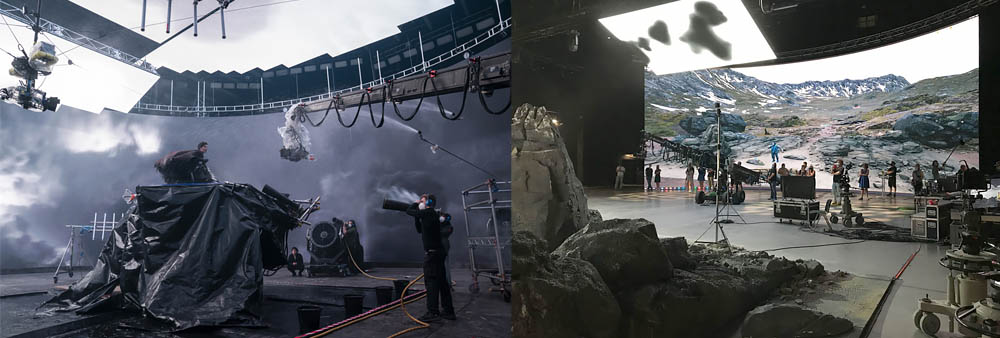
In this method, a large LED enclosure or volume is constructed, with walls completely covered by LED panels. These panels can display highly detailed digital environments in real time. As a result, spaces such as forests, cities, or even fantastical worlds are projected directly to the actors during filming. StageCraft is a flexible technology that can replace both green and blue screens in visual effects production. The process includes:
-
Creating digital environments: Designers build the digital backgrounds, from natural landscapes to complex structures, which will appear behind the live-action scene.
-
Displaying on LED panels: These digital environments are projected in real time across the LED walls surrounding the set.
-
Filming and acting: Actors perform within these realistic digital environments, and the natural lighting and reflections make the scene appear far more authentic.
-
Natural lighting: Light emitted by the digital environment falls directly on actors and physical sets, producing a more realistic and integrated visual result.
Advantages of LED Volume / StageCraft
-
Improved actor performance: Actors can interact with a realistic environment instead of performing in front of a blank green screen and imagining the surroundings.
-
Time and cost efficiency: There’s no need to travel to remote locations or build complex physical sets.
-
Higher quality lighting: Digital environment lighting naturally illuminates actors and props, creating more realistic visuals.
-
Reduced post-production workload: Since visual effects and virtual environments are generated in-camera during filming, the need for extensive post-production work is minimized.
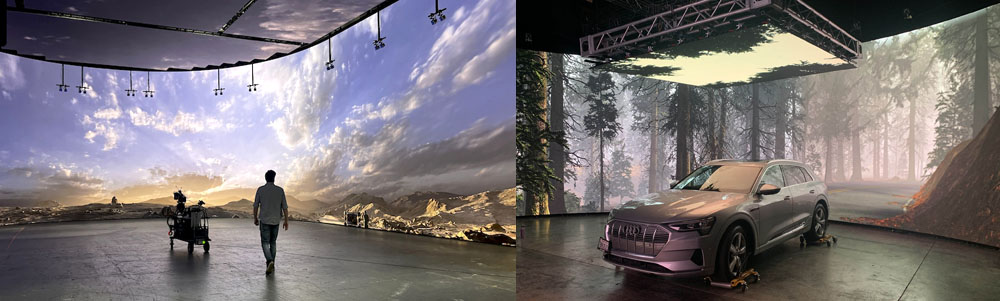
Disadvantages and Limitations of StageCraft
While LED Volume or StageCraft technology offers numerous advantages, like any technology, it also has limitations that need to be considered. Currently, it cannot entirely replace traditional green screens, although in many cases it serves as a powerful and advanced alternative.
Key Limitations:
-
High initial costs:
Building and installing an LED Volume requires a significant investment. Constructing a large space equipped with LED panels and complex systems for processing and synchronizing virtual images can be very expensive. Such costs may not be feasible for smaller projects or low-budget productions. -
Scale limitations:
While LED Volumes are ideal for interior sets or reasonably sized environments, creating a very large LED space for expansive scenes (like vast landscapes or open natural environments) is challenging. The size of LED panels imposes limits, making it difficult to simulate truly endless or massive environments. -
Natural lighting challenges:
Filming outdoors or under specific lighting conditions, such as nighttime, can make it difficult to match natural light with the artificial lighting produced by the LED Volume. In some cases, the lighting may not integrate perfectly with real-world light conditions. -
Limited flexibility in certain scenarios:
Some adjustments or specific details that are easily achievable with green screens might be more difficult or time-consuming in an LED Volume. Unlike green screen setups, where environments can be entirely changed in post-production, LED Volumes display environments live and in real time, limiting post-shoot modifications. -
Potential unnatural effects:
Displaying digital imagery on LED panels can sometimes create artificial or unnatural effects, especially when combined with physical sets. If the alignment between digital imagery and actors or physical objects is not precise, the visual realism of the scene may be compromised.
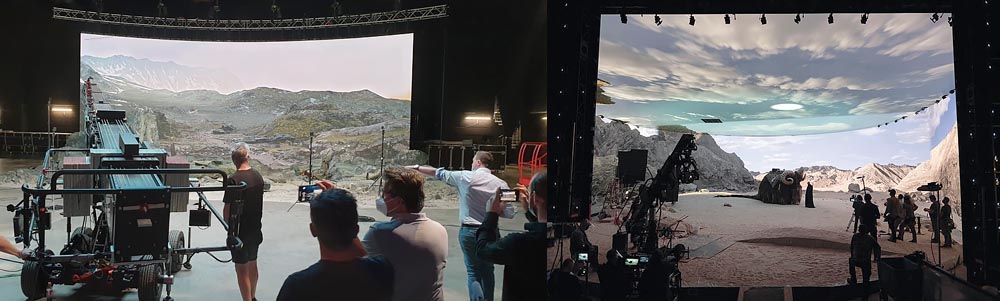
Suitable Locations and Spaces for Using LED Volume Technology
StageCraft technology generally requires specific environmental conditions to function optimally. It is designed to integrate digital visual effects with the real world within a controlled studio environment and cannot be deployed just anywhere. The following are key requirements for implementing LED Volume technology:
1. Adequate Physical Space
A large enough area is needed to install high-quality LED panels, sometimes spanning several hundred square meters, to create immersive 360-degree virtual environments. Such expansive spaces are typically available in professional studios or dedicated film production centers. The panels must be arranged around the set to fully surround actors and physical props.
2. High Initial Costs
Due to the need for premium LED panels and complex computer systems to synchronize real-time imagery, LED Volume technology is expensive. Consequently, it is primarily used for large-scale Hollywood films, high-budget series, or major productions.
3. Advanced Hardware and Software Systems
Powerful hardware is required to manage LED panels, control live images, and synchronize them with camera movements. In addition, specialized software is necessary to create, control, and render virtual environments in real time.
4. Camera Movement Support
One of StageCraft’s key features is that virtual environments adapt precisely and in real time to camera movements. This means the system must simultaneously track the camera’s position and angle and adjust the virtual imagery accordingly. Advanced tracking technologies are therefore essential for proper implementation.
5. Controlled Studio Environment
LED Volume technology is best used in controlled studio environments where lighting, temperature, and other environmental factors can be precisely managed. This ensures that virtual imagery maintains high quality and is not negatively affected by external factors such as natural light or temperature fluctuations.
Summary:
LED Volume or StageCraft is primarily designed for large, professional studios with specialized infrastructure. It is not easily deployable in casual or everyday locations and is optimized for high-budget film and television productions that require complex virtual environments.
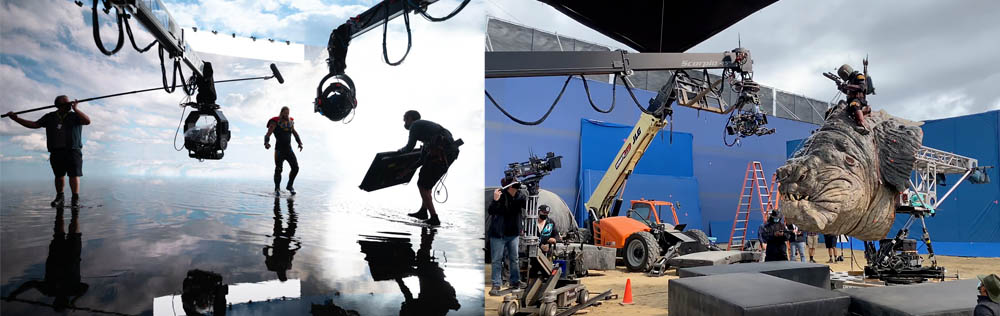
Is StageCraft a Replacement for Green Screen?
Currently, LED Volume can serve as a substitute for green screens in many scenarios, particularly in indoor environments or locations where filming outdoors or in remote areas is challenging. However, green screens still remain the preferred choice for wide-open locations, projects requiring extensive environments, or situations demanding maximum flexibility in post-production.
In other words, StageCraft and green screens can complement each other, and the choice between them depends on the type of project, VFX requirements, and available resources. While LED Volume and StageCraft have become powerful tools in the VFX world, they cannot completely replace green screens. Their usage is highly dependent on project specifics and production conditions.
Public Accessibility of StageCraft Technology
Initially exclusive to ILM, StageCraft is now more widely accessible and no longer limited to internal ILM projects. After the technology’s success in high-profile productions like The Mandalorian, ILM began sharing and expanding access.
Collaboration with other studios: ILM now allows other studios and production companies to utilize StageCraft. They have officially offered the technology to external film and TV studios. Additionally, ILM has partnered with companies like Epic Games (creator of Unreal Engine) to enhance the technology for creating virtual environments and integrating with LED panels.
Shared platforms: Several other studios are also investing in LED Volume systems similar to StageCraft, expanding the technology’s reach in the industry. Companies like The Third Floor and Framestore have developed and applied similar systems for their productions.
Available equipment and services: Film studios around the world can now implement LED Volume technology for their projects. This includes independent producers, TV studios, and even smaller production houses, making the technology much more accessible than when it was initially developed.
About John Knoll – ILM Engineer and Visual Effects Pioneer
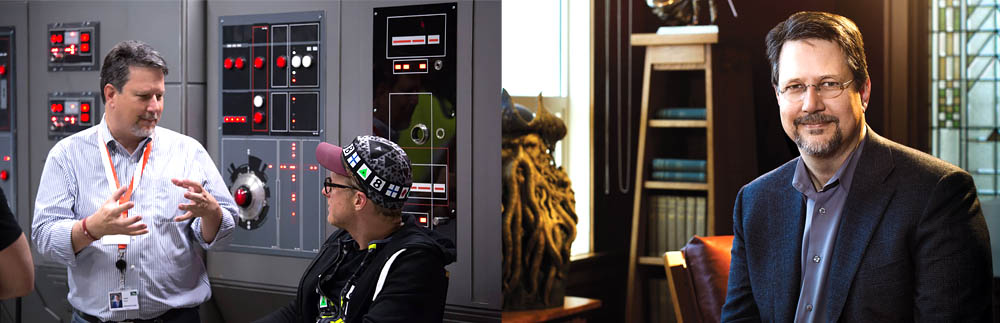
John Knoll is a leading engineer and VFX innovator, widely recognized as one of the founders and executive members of Industrial Light & Magic (ILM). He is especially known for his pioneering contributions to advanced VFX technologies in Hollywood films.
-
Birth: October 24, 1962, United States
-
Education: Bachelor’s degree in Electrical Engineering from the University of California, Berkeley
-
Significance: His technical background helped him develop a deep understanding of digital technologies and the complexities of visual effects, including contributions to StageCraft and other cutting-edge VFX systems.
Professional Achievements of John Knoll in Visual Effects and CG
Development of Innovative VFX Technologies:
John Knoll is recognized as a pioneer in digital visual effects, having contributed to numerous groundbreaking innovations in the field. One of his major achievements at ILM was developing digital systems that seamlessly integrate visual effects with live-action footage, significantly impacting the way blockbuster films are produced.
StageCraft and LED Volume Technology:
John Knoll played a key role, alongside his team at ILM, in developing the LED Volume technology, also known as StageCraft. This system allows filmmakers to use large LED screens to create realistic virtual environments in real-time during filming. One of the earliest and most notable projects to utilize this technology was the TV series The Mandalorian.
Photoshop Software:
John Knoll, together with his brother Thomas Knoll, co-created Adobe Photoshop. In 1987, the brothers developed Photoshop to enable digital image editing. John, who at the time worked at Pixar, initially designed the software for Macintosh systems. Later, after collaboration with Adobe Systems, Photoshop became one of the most prominent and widely used tools in the graphic design industry, eventually being released for Windows as well.
Contributions to Major Films:
John Knoll has been instrumental in creating visual effects for numerous high-profile Hollywood films, including:
-
Star Wars: Episode I – The Phantom Menace
-
Jurassic Park
-
Pirates of the Caribbean
and many others. His work has been crucial in advancing digital VFX and seamless integration with live-action footage in these productions.
Awards and Honors:
In recognition of his contributions, John Knoll has received multiple awards, including:
-
Academy Awards (Oscars) for technical achievements
-
Several honors from the Academy of Motion Picture Arts and Sciences for his technical innovations in VFX
Technical Expertise:
As an engineer and technician, John Knoll specializes in:
-
Computer programming
-
Computer graphics algorithms
-
Compositing digital and live-action images
These skills have made him a central figure in the evolution of visual effects and digital production.
Summary:
Overall, John Knoll is one of the most influential figures in the history of cinema and visual effects. Through his development of advanced technologies, he has enabled new, immersive, and innovative visual experiences, shaping the modern landscape of film and digital entertainment.
Projects Created Using StageCraft Technology
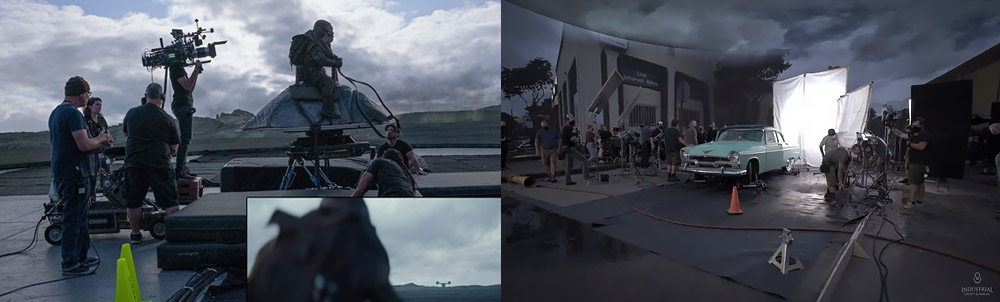
StageCraft technology has been employed in several major film and television productions. It has become particularly popular in modern productions that require real-time virtual environments. Below are some of the notable projects that have utilized this technology:
The Mandalorian (2019):
One of the most prominent projects to use LED Volume technology, The Mandalorian premiered on Disney+ in 2019. The series utilized 360-degree LED screens to simulate various virtual environments. This approach allowed large portions of the series to be filmed without traveling to external locations or using traditional green screens.
The Book of Boba Fett (2021):
This spin-off of The Mandalorian also leveraged LED Volume technology. It was particularly used to create desert landscapes and futuristic cityscapes. Similar to The Mandalorian, the environments were designed virtually using LED Volume, enabling the production of complex, realistic outdoor scenes.
Obi-Wan Kenobi (2022):
As another Star Wars spin-off, Obi-Wan Kenobi employed LED Volume to simulate diverse environments. Using technical features similar to The Mandalorian, the series effectively created dynamic and visually compelling scenes of different planets and locations, while maintaining cost efficiency.
The Lion King (2019):
The 2019 remake of The Lion King, directed by Jon Favreau, is another production that utilized LED Volume technology. The film employed similar systems to create highly detailed 3D virtual environments, especially for outdoor sequences such as forests and savannahs, providing a realistic and immersive experience.
Additional Projects Using StageCraft Technology
The Mandalorian: Season 2 (2020):
The second season of The Mandalorian continued to utilize LED Volume technology for creating virtual environments and filming realistic locations. This season particularly benefited from the technology in scenes requiring complex outdoor settings or alien planets.
Avatar 2 (2022):
James Cameron’s Avatar 2 (released in 2022) employed advanced technologies to combine real and digital imagery. While the film is primarily known for its 3D technology and visual effects, LED Volume was also used for certain simulated environments to enhance realism.
Westworld (2016–2022):
The television series Westworld incorporated LED Volume in its later seasons to create complex, mobile virtual environments. The system was used to display the immersive virtual worlds within Westworld in real time.
Lost in Space (2018–2021):
Netflix’s Lost in Space used advanced technologies for depicting space and outdoor planetary environments. Several space and desert scenes were created using LED Volume, producing more realistic and natural visuals for these otherworldly settings.
Thor: Love and Thunder (2022):
Marvel’s Thor: Love and Thunder leveraged LED Volume technology for some of its unique environments. Known for its visual effects-heavy productions, the film used this technology to create certain space scenes and alien worlds with high realism.

Sadjad Jahangiri
![Verified]()