
Where Did the Story Begin?
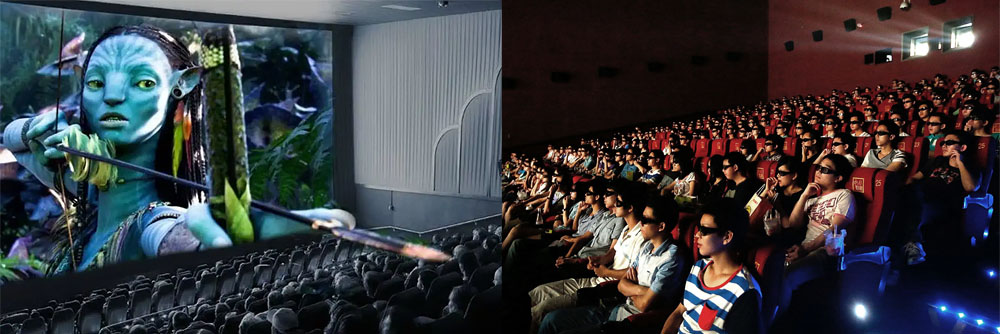
The first stereoscope was invented by Charles Wheatstone in 1838. This device experimentally used 2D images, presenting a different image of the same scene to each eye to create a virtual sense of depth. Later, in cinema particularly during the 1950s and 1980s—early versions of 3D films were produced. With the advancement of digital technology in the 2000s, high-quality and high-resolution 3D films regained popularity.
Why Stereoscopy is Attractive for Film
In cinema, stereoscopy is used to create a more immersive and realistic experience of space and depth. This method allows viewers to feel that objects and characters are at varying distances from them, as if they are truly present in the film’s world. This feature is especially compelling for action scenes, visual effects, and science-fiction films, making the viewing experience more exciting for the audience.
The Role of Stereoscopy in VFX and CG and Its Operational Mechanism
Stereoscopy holds a special position in the fields of visual effects (VFX) and computer graphics (CG). It is used as part of the content creation process for cinema, games, and even advertising to provide depth and an immersive experience for the viewer. Specifically, stereoscopy plays a key role in the stages of design, visual effects creation, and compositing.
Stereoscopy in VFX and CG serves two main purposes:
-
Creating a Sense of Depth and Realism: In major cinematic and VFX projects, stereoscopy allows designers to add more depth and realism to scenes. Using this technology, designers can create high-resolution 3D images with appropriate depth for each eye. This is particularly important for action films, science-fiction, and animations that require the creation of imaginary worlds and unreal environments.
-
Enhancing Interaction and Engagement in User Experience: In video games, stereoscopy provides players with a deeper and more realistic perception of the game world. In certain 3D games designed for stereoscopic displays, computer graphics are created so that users can perceive the environment with greater depth and feel immersed in it. This method has become especially widespread in virtual reality (VR) and augmented reality (AR) applications.
Stereoscopy is applied in various stages of CG and VFX content production:
3D Modeling: To create three-dimensional scenes, stereoscopy helps designers model in a way that properly aligns angles and depth. In this stage, 3D images are set up with two virtual cameras to capture the correct perspective.
Stereoscopic Rendering: During the rendering stage, final images are produced using two virtual cameras. Each camera captures a separate view of the scene for each eye, ultimately generating a 3D image with appropriate depth.
3D Compositing: In the compositing stage, the images from both cameras are combined, and 3D effects are added to the scene considering the position and depth of objects. Software like Nuke and After Effects provide extensive tools for stereoscopic compositing.
Tools and Software Used for Stereoscopy in VFX and CG
Several key software and tools are widely used for stereoscopy in VFX and CG, including:
Autodesk Maya and 3ds Max: These programs allow creators to adjust camera angles and the proper distance between two cameras to produce realistic 3D images. They are extensively used in visual effects, offering capabilities for scene simulation and 3D creation. Many animations and 3D effects that require depth are produced using these tools.
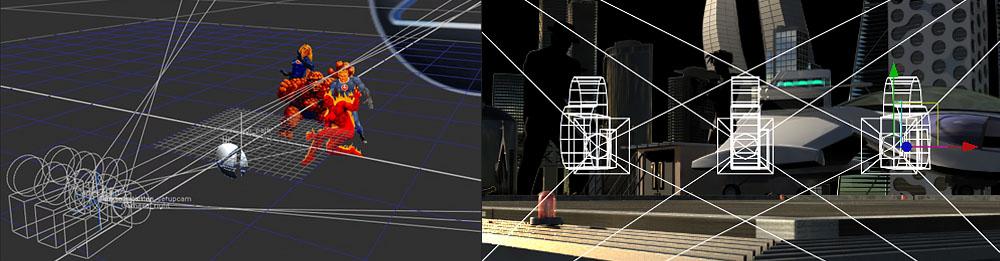
The Foundry Nuke: One of the leading compositing software, Nuke offers advanced tools for managing and combining 3D images. It is widely recognized as one of the top programs for compositing and converting 2D footage into 3D. With its extensive 3D capabilities and depth management, Nuke enables the creation of highly realistic stereoscopic images.
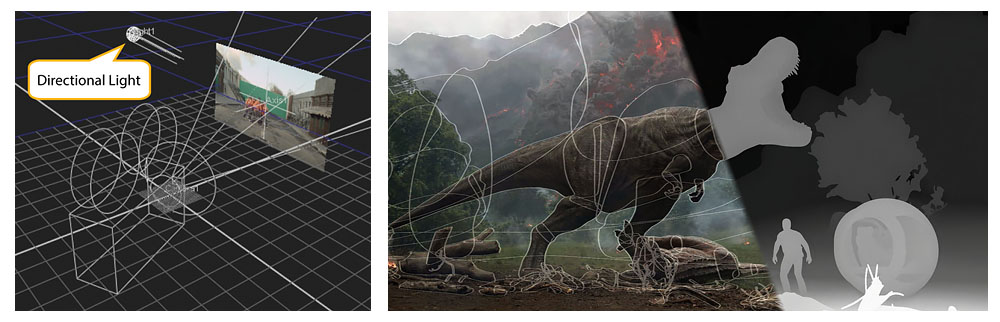
Adobe After Effects: Although not fully specialized in 3D film conversion, After Effects can add depth to footage with the help of various plugins, enabling stereoscopic adjustments and effects.
Cinema 4D and Blender: These software programs are used in computer graphics and visual effects projects and support stereoscopic features for creating 3D content.
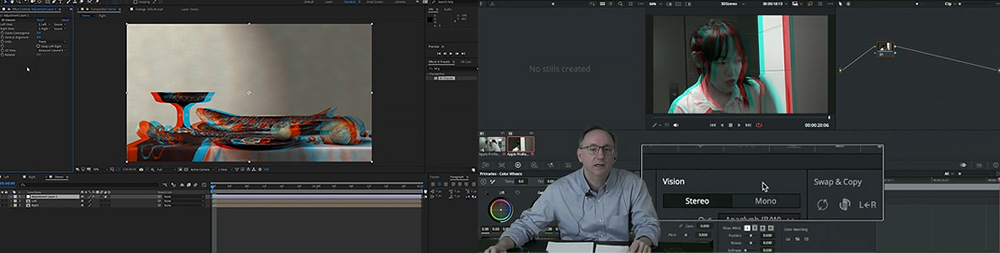
DaVinci Resolve: Primarily used for color grading and final output of 3D films, DaVinci Resolve enhances stereoscopic settings and provides tools for precise depth adjustment and 3D effects.
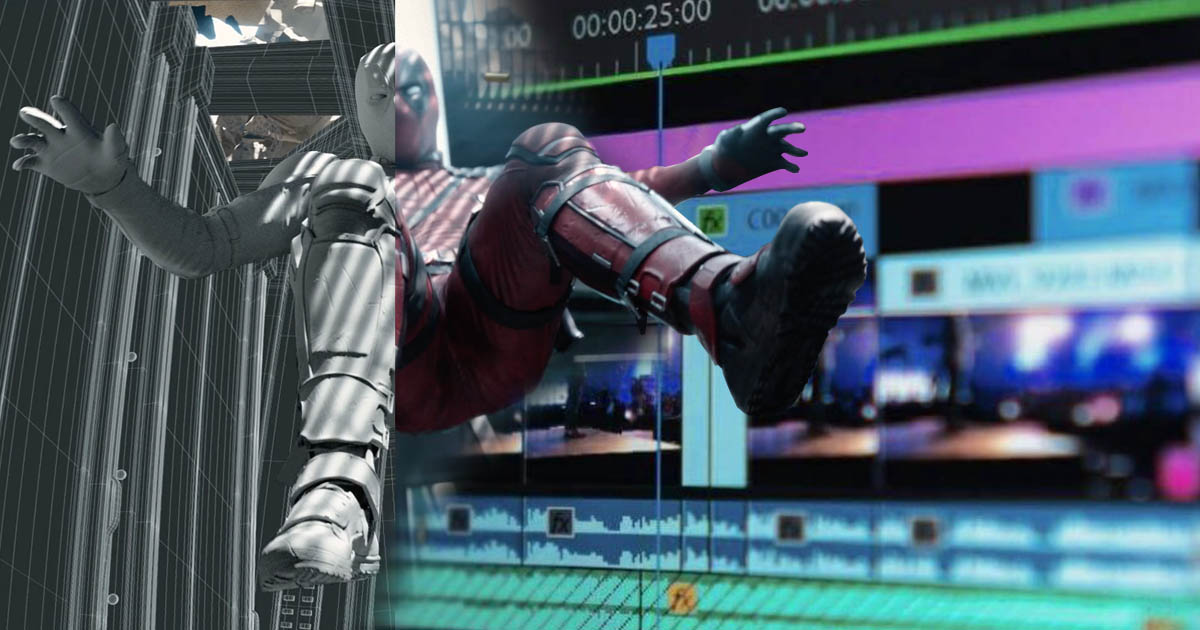
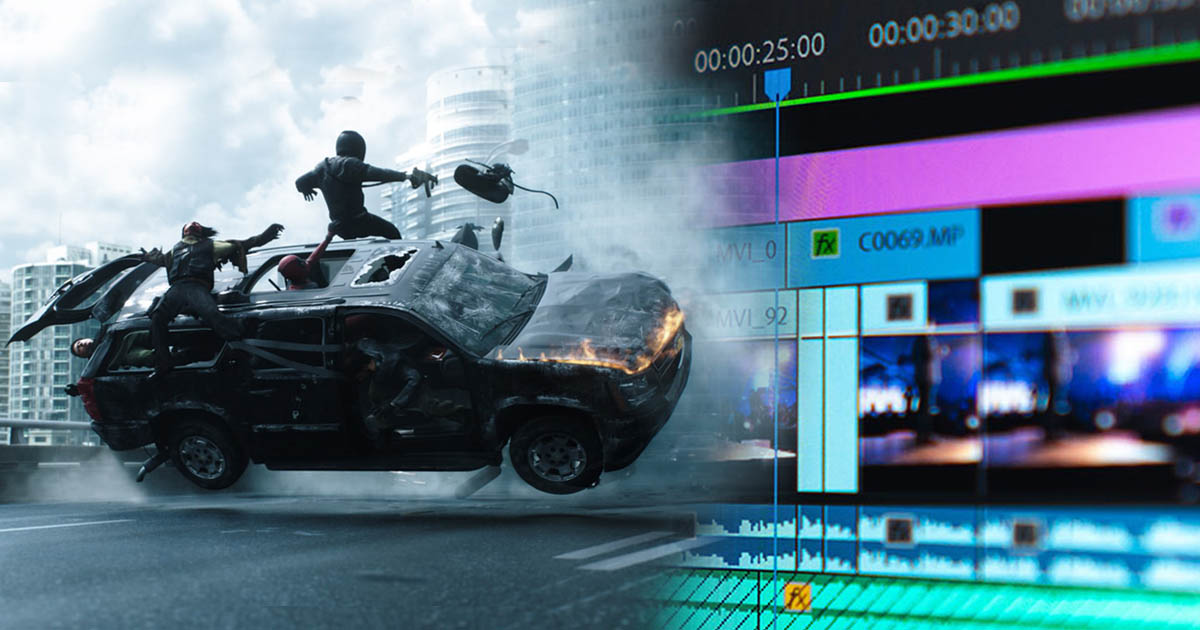
You can see examples of stereoscopy implementation in DaVinci Resolve and After Effects in the image below.
Challenges and Advantages of Stereoscopy in VFX and CG
Advantages: Stereoscopy enhances visual appeal, creates a more realistic and immersive experience, and makes films and video games more engaging and exciting.
Challenges: Implementing stereoscopy can be costly and time-consuming, requiring precise camera alignment and angle settings. If depth or angles are not correctly configured, it can disrupt the viewer's experience, causing eye strain, fatigue, or headaches. Overall, stereoscopy holds a crucial role in VFX and CG, significantly improving visual quality and the appeal of 3D content.
Impact of Stereoscopy on Film Viewing and Audience Experience
Stereoscopy makes scenes appear more lifelike and three-dimensional, giving the impression that objects are coming out of the screen. This technique adds excitement and depth, particularly in films with heavy visual effects, increasing audience engagement. For some viewers, watching a 3D film provides a thrilling and unique experience, as the depth of the image gives a stronger sense of presence in the story and scenes. However, some viewers may experience dizziness, headaches, or eye fatigue because the brain must merge two separate images simultaneously.
Stages of Stereoscopy in 3D Film Production
For creating 3D films in cinema, stereoscopy can be implemented either during filming or in post-production. Each method requires specific tools and software.
1. Stereoscopy During Filming: In this method, 3D filming is done using specialized 3D cameras that record simultaneously from two slightly different angles (one for each eye). Key tools and cameras used in this method include:
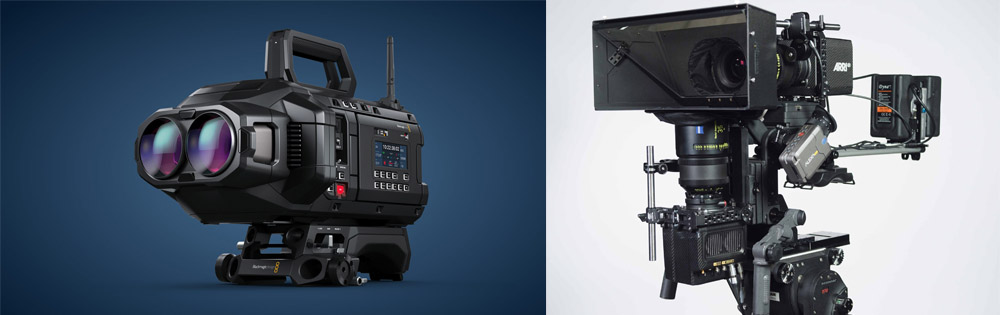
1.1 Dual-lens 3D Cameras: These cameras are equipped with two lenses, each capturing the scene from slightly different angles. Companies like RED, Sony, and Panavision manufacture professional 3D cameras for this purpose.
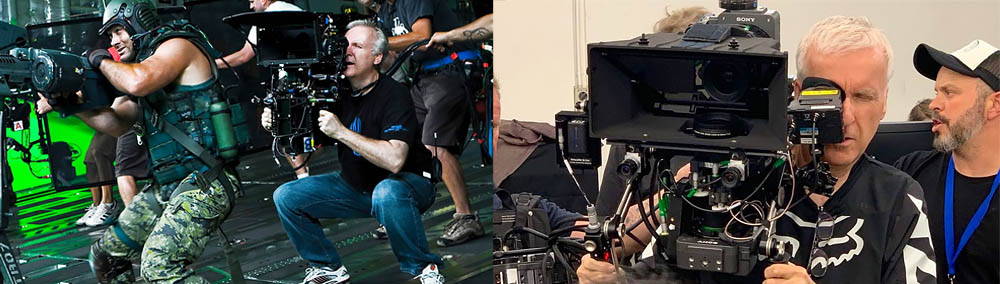
1.2 3D Rigs: For filming with two cameras placed either in parallel or at a distance similar to human eyes, adjustment tools called rigs are used. These rigs control the angle and distance between the two cameras to produce a proper 3D image.
1.3 Real-time Monitoring Software: To monitor and control 3D images during filming, software such as 3ality Technica and Element Technica is used. These tools allow filmmakers to view and adjust the angles and spacing between the two images live.
2. Post-production Stereoscopy (2D to 3D Conversion): Sometimes films are shot in 2D and later converted to 3D using specialized software. This method is usually time-consuming and costly but is suitable for films where 3D filming was not possible. The main software used for this conversion has been mentioned previously.
Advantages and Disadvantages of Each Method
3D Filming During Production: Captures real depth, resulting in more realistic images, but requires specialized equipment and higher costs.
2D-to-3D Conversion Post-production: More flexible and can be applied to pre-existing films, but it is time-consuming and expensive for processing and editing. Both methods can be used depending on the film’s requirements and production resources, and they have significantly different visual impacts on the final movie and viewer experience.
Converting Older Films to 3D
Older films can also be converted to 3D using digital conversion techniques. This process involves analyzing and separating the elements in each frame, creating multiple layers to add depth and dimension. Ultimately, a second image is generated for each frame from a slightly different angle to make it suitable for 3D viewing.
This process is time-consuming and costly because each frame must be carefully examined and the depth of its elements precisely determined. Therefore, mostly highly popular or financially successful films undergo this conversion. For example, classic films like Star Wars and Jurassic Park have been converted to 3D with modern technology.
However, any film can technically be converted to 3D, but the final quality depends on factors like the original film’s resolution and lighting conditions.
3D Glasses for Watching 3D Films
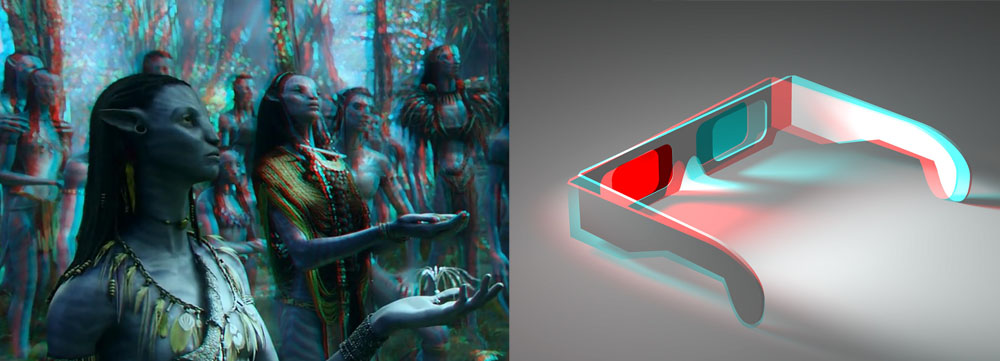
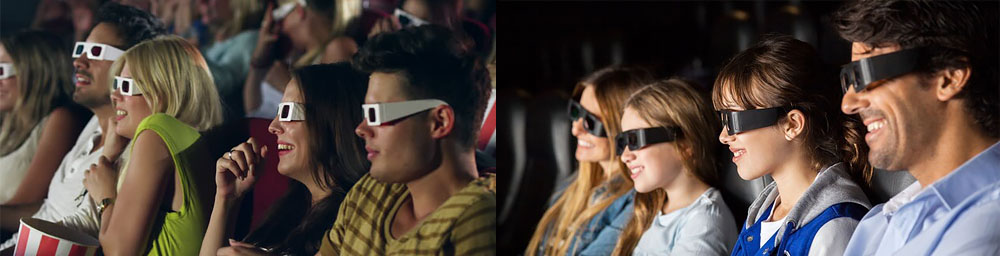
To watch 3D films, special 3D glasses are required. These glasses are designed so that each eye sees a slightly different image of the same scene. The brain combines these two images, creating the perception of depth and dimension. Without these glasses, proper 3D viewing is not possible.
Types of 3D Glasses:
Anaglyph Glasses: These glasses have one red lens and one blue or green lens. The film’s images are processed so that each color channel corresponds to one lens. The brain combines these colored images, producing the perception of depth. These glasses are inexpensive but reduce the color quality of the image.
method, the images on the screen are displayed with two different polarizations, and the lenses of the glasses, with their polarized filters, ensure that each eye sees only its intended image. These glasses are more common in 3D cinemas and offer good color and image quality.
Active Shutter Glasses: These glasses have LCD lenses that rapidly alternate in sync with the display, so each eye sees its designated image. Active shutter glasses require batteries and work with specific 3D displays. They provide very high image quality, but are more expensive and slightly heavier.
Color-coded Glasses: In this type of glasses, each lens is assigned a different color, and the film images are encoded to match these colors. This technique offers quality similar to anaglyph glasses but is used for certain specialized 3D applications.
Necessity of 3D Glasses:
To properly and effectively watch 3D movies, 3D glasses are essential. Without them, the images appear double or blurry to the viewer because each eye cannot independently receive a complete and clear view of the scene. The brain cannot correctly merge the images, resulting in an incomplete 3D experience.
Glasses-free Methods (Autostereoscopy):
Some 3D displays can provide stereoscopic images without the need for glasses, using technologies such as lenticular lenses or parallax barriers. These displays can deliver different images to each eye without requiring glasses. This technology is typically used in smaller devices, such as certain tablets and handheld consoles (like the Nintendo 3DS), but it is not yet widely adopted for cinemas or large displays because creating proper viewing angles on bigger screens is more challenging.
Currently, for watching 3D movies in cinemas and on home TVs, 3D glasses remain an integral part of the experience and are essential for creating the perception of depth. Glasses-free technologies are advancing, but they have not yet become a fully practical and cost-effective replacement for 3D glasses on large-scale displays.
Use, Development by Companies, and Intellectual Property
Currently, many companies, especially in the film and content production industries, have developed proprietary technologies and tools for stereoscopy and 3D filmmaking. Companies such as Dolby, RealD, IMAX, and 3ality Technica are among the pioneers in developing stereoscopic technologies for cinema. Each of these companies may offer unique methods and equipment for filming or displaying 3D movies, but stereoscopy itself is not owned by any single company.
Certain aspects and tools of the stereoscopy process—such as 3D cameras, adjustment rigs, or 3D displays may be patented or proprietary products owned by various companies. These companies hold legal rights to their specific equipment and software, and sometimes license the use of their technologies to others.
Standards and Regulations in Stereoscopy and Related Organizations
At the same time, there are industry standards for stereoscopy, defined by professional organizations such as SMPTE (Society of Motion Picture and Television Engineers) and ISO (International Organization for Standardization). These standards help ensure that stereoscopic technology is applied consistently and with high quality in cinematic productions and other fields.
In summary, stereoscopy is a freely usable technology across different industries and is not owned by any single entity. However, many companies develop proprietary tools, software, or methods for stereoscopic applications.
In cinema and 3D content production, standards and industry guidelines exist to ensure visual quality and prevent viewer discomfort. Some of the most important standards and regulations related to stereoscopy include:
-
SMPTE Standards (Society of Motion Picture and Television Engineers): SMPTE provides standards for the production, display, and editing of 3D films. These standards cover correct distances, angles, and settings for 3D cameras, as well as technical specifications for displays.
ISO Standards (International Organization for Standardization):
ISO also has standards related to stereoscopy and 3D display, which help filmmakers and equipment manufacturers ensure that their products comply with global standards.
Ergonomic and Visual Health Guidelines:
To prevent issues such as eye strain and headaches, certain design standards for 3D displays are considered. These include settings for the distance between the two cameras, maximum depth of the image, and minimum distance of objects within the scene.
Guidelines from the European Stereoscopic Union (ESU):
This organization provides standards and recommendations for the safe and efficient production of 3D content, including principles of design, composition, and layout in stereoscopic images.
Stereoscopy as a Science:
Stereoscopy is a scientific field with applications across cinema, visual sciences, neuroscience, and optics. In vision science and optics, stereoscopy studies how the brain and eyes perceive depth. Its findings improve our understanding of visual system function and how the brain processes images. This scientific knowledge, combined with technical principles and standards, helps filmmakers and technicians produce professional 3D films that deliver high-quality and safe experiences for viewers.
In summary, stereoscopy is both a science with established principles and laws and an industry practice with technical standards and guidelines for creating 3D content. Fundamentally, stereoscopy operates based on scientific and physical principles. It relies on binocular vision and how the human brain processes depth and distance. From a scientific perspective, stereoscopy intersects with optics, visual psychology, and biology, contributing to our understanding of how the brain perceives depth and spatial relationships.
Necessity of Stereoscopy Implementation:
The use of stereoscopy is not always required; it depends on the director's goals, the type of film, and audience preferences. For films that rely heavily on visual effects or require a sense of depth and space, stereoscopy can enhance the viewing experience. However, for films focused more on story and characters, this technique may be less essential and might even distract the viewer from the main narrative. Overall, stereoscopy can provide a unique and engaging experience, but it is not mandatory for all films or audiences and should be applied according to the film’s style and target viewers.

Sadjad Jahangiri
![Verified]()